Primary documents
The documents
Nine documents from 1954 to 1997, transcribed verbatim and set beside the page scans they come from.
The transcripts are verbatim. [illegible] marks unreadable text, [word?]
marks an uncertain reading, [sic] marks an error that is in the original, and square
brackets restore characters that the scan crops. Underlined words in a source document appear
underlined here. Click any page image to enlarge it.
Two letters in the exchange were never reprinted. They appear below as gaps, in date order. The engineering sheets from the May 1997 issue are on the drawings page.
Timeline
- March 1954 / January 1955Russell and Royal Lee on Nikola Tesla
- August 8, 1958Walter Russell's coil description — not reprinted
- August 25, 1958Dube proposes the test protocol
- August 30, 1958The Russells approve the plan
- October 3, 1958Dube's letter with the revised drawings — not reprinted
- October 5, 1958The prediction: a 40 to 60 percent advantage
- November 21, 1958Dube reports the result
- November 1958 (enclosure)Report on Evaluation of Russell Coil
- November 24, 1958The Russells concede
- October 1996The 1996 editor's note
- May 1997The 1997 editor's introduction
1. Russell and Royal Lee on Nikola Tesla
Two letters, plus the 1996 editor's note that calls them the only trace of the Russell–Tesla association in the USP archives. Neither letter mentions secrecy.
Conventions: the transcription is verbatim. [illegible] = unreadable. [word?] = uncertain reading. Underlined words in the original appear underlined here.
Editor's note (1996), journal p. 15 head — continues at foot of p. 16
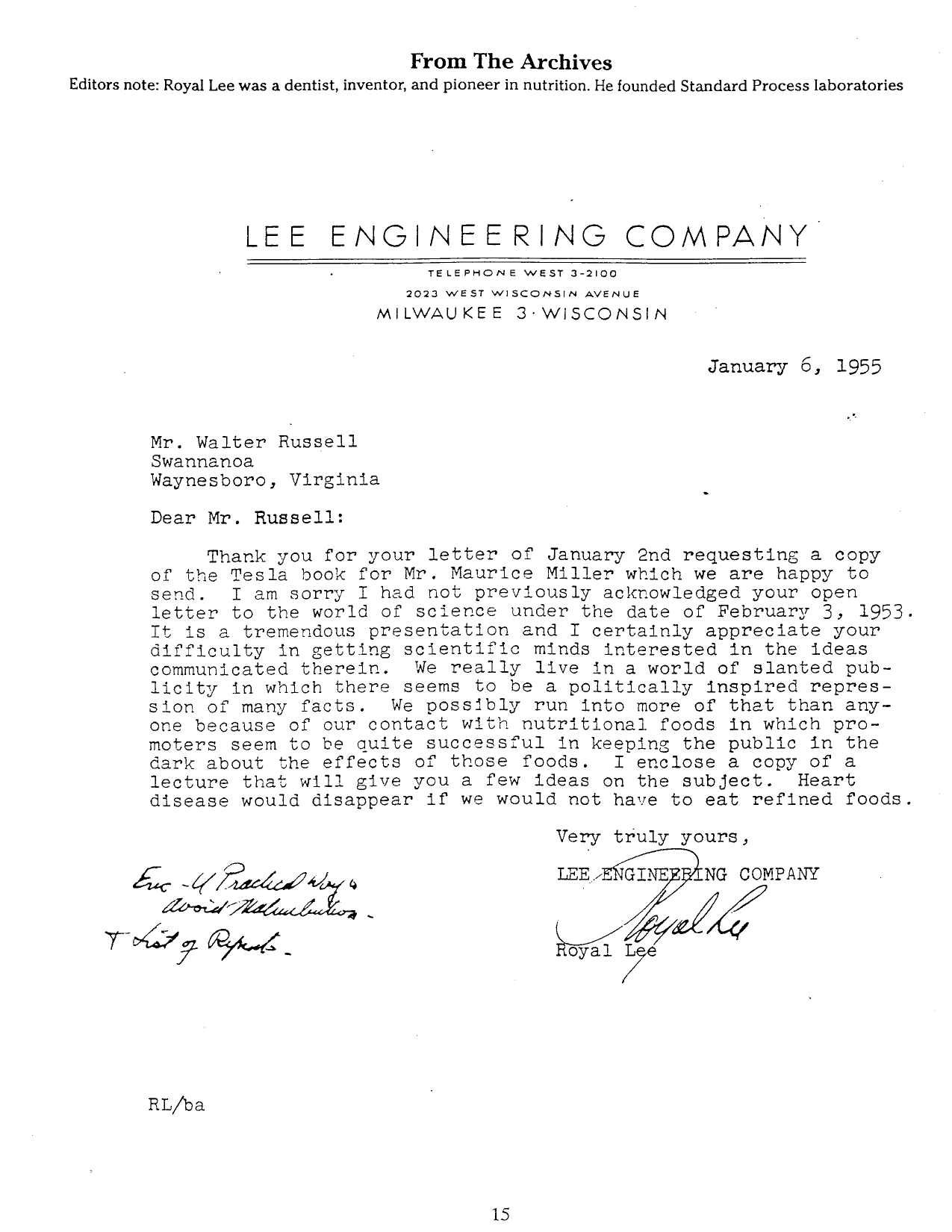
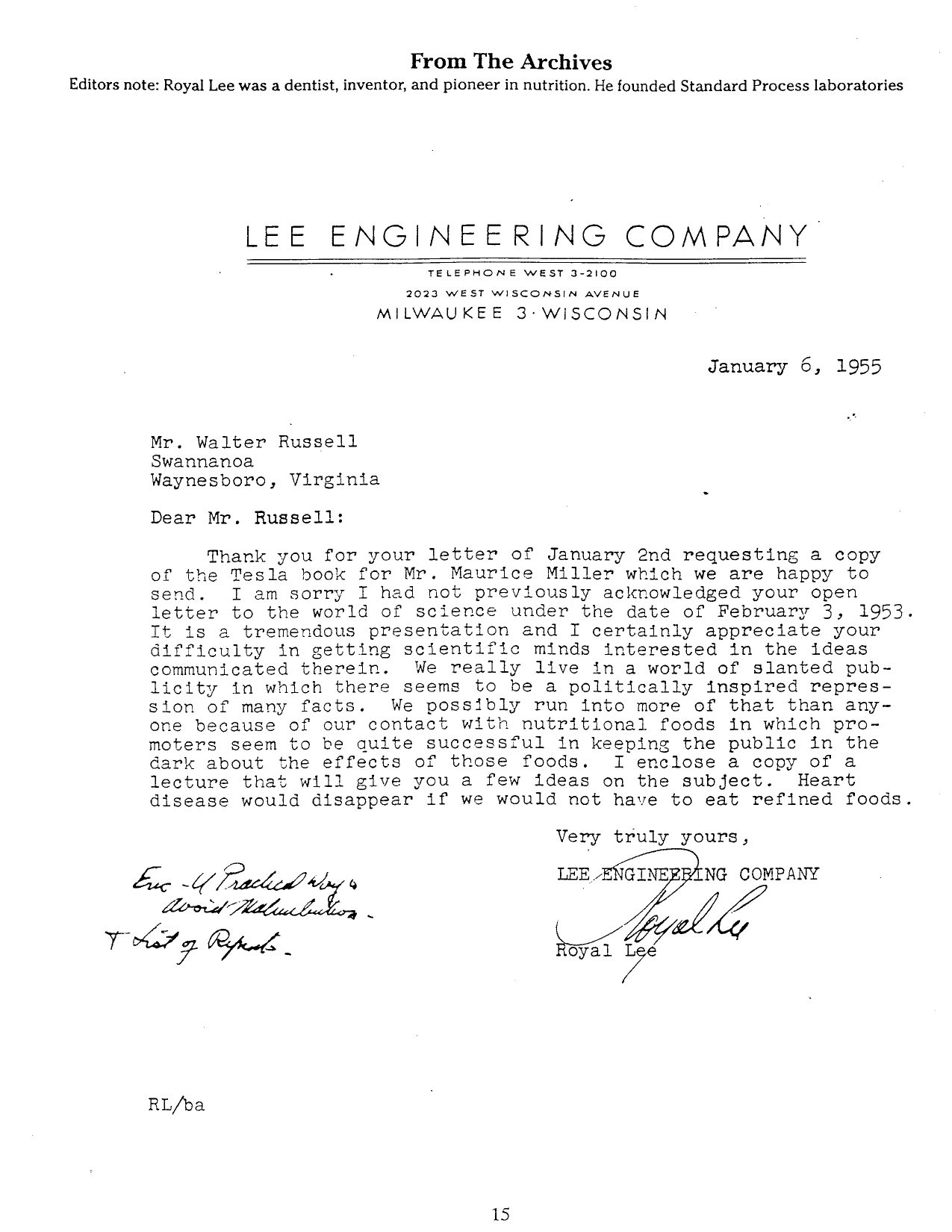
From The Archives
Editors note: Royal Lee was a dentist, inventor, and pioneer in nutrition. He founded Standard Process laboratories
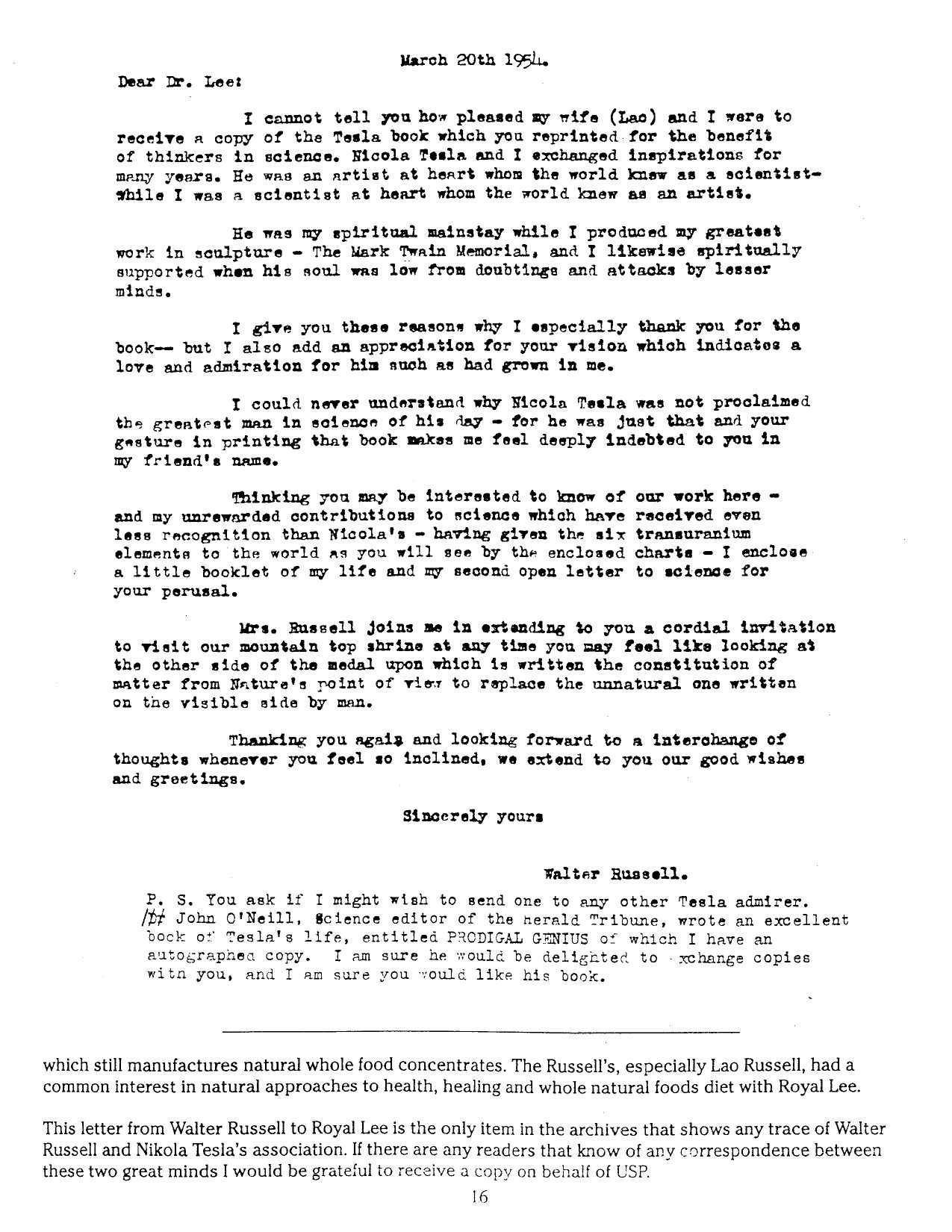
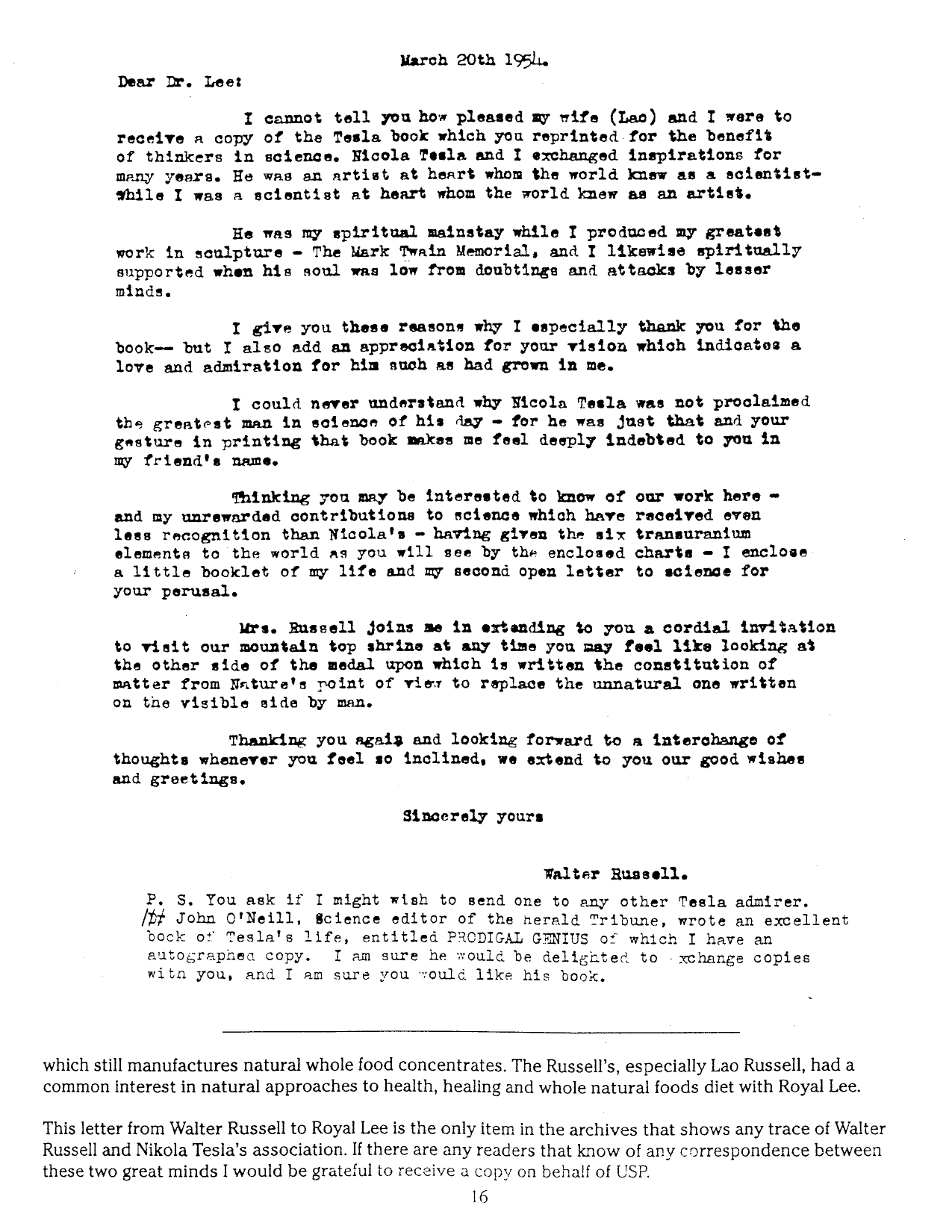
(continuation, journal p. 16 foot:)
which still manufactures natural whole food concentrates. The Russell's, especially Lao Russell, had a common interest in natural approaches to health, healing and whole natural foods diet with Royal Lee.
This letter from Walter Russell to Royal Lee is the only item in the archives that shows any trace of Walter Russell and Nikola Tesla's association. If there are any readers that know of any correspondence between these two great minds I would be grateful to receive a copy on behalf of USP.
Document 1 — Royal Lee to Walter Russell (journal p. 15 / PDF 18)
LEE ENGINEERING COMPANY
TELEPHONE WEST 3-2100
2023 WEST WISCONSIN AVENUE
MILWAUKEE 3 · WISCONSIN
January 6, 1955
Mr. Walter Russell
Swannanoa
Waynesboro, Virginia
Dear Mr. Russell:
Thank you for your letter of January 2nd requesting a copy
of the Tesla book for Mr. Maurice Miller which we are happy to
send.  I am sorry I had not previously acknowledged your open
letter to the world of science under the date of February 3, 1953.
It is a tremendous presentation and I certainly appreciate your
difficulty in getting scientific minds interested in the ideas
communicated therein.  We really live in a world of slanted pub-
licity in which there seems to be a politically inspired repres-
sion of many facts.  We possibly run into more of that than any-
one because of our contact with nutritional foods in which pro-
moters seem to be quite successful in keeping the public in the
dark about the effects of those foods.  I enclose a copy of a
lecture that will give you a few ideas on the subject.  Heart
disease would disappear if we would not have to eat refined foods.
Very truly yours,
LEE ENGINEERING COMPANY
[signature: Royal Lee]
Royal Lee
(handwritten, lower left:) Enc – [4?] Practical Way[s?] [to?]
avoid Malnutrition –
[+?] List of Reprints –
RL/ba
Document 2 — Walter Russell to Dr. Royal Lee (journal p. 16 / PDF 19)
March 20th 1954.
Dear Dr. Lee:
I cannot tell you how pleased my wife (Lao) and I were to
receive a copy of the Tesla book which you reprinted for the benefit
of thinkers in science. Nicola Tesla and I exchanged inspirations for
many years. He was an artist at heart whom the world knew as a scientist-
while I was a scientist at heart whom the world knew as an artist.
He was my spiritual mainstay while I produced my greatest
work in sculpture - The Mark Twain Memorial, and I likewise spiritually
supported when his soul was low from doubtings and attacks by lesser
minds.
I give you these reasons why I especially thank you for the
book-- but I also add an appreciation for your vision which indicates a
love and admiration for him such as had grown in me.
I could never understand why Nicola Tesla was not proclaimed
the greatest man in science of his day - for he was just that and your
gesture in printing that book makes me feel deeply indebted to you in
my friend's name.
Thinking you may be interested to know of our work here -
and my unrewarded contributions to science which have received even
less recognition than Nicola's - having given the six transuranium
elements to the world as you will see by the enclosed charts - I enclose
a little booklet of my life and my second open letter to science for
your perusal.
Mrs. Russell joins me in extending to you a cordial invitation
to visit our mountain top shrine at any time you may feel like looking at
the other side of the medal upon which is written the constitution of
matter from Nature's point of view to replace the unnatural one written
on the visible side by man.
Thanking you again and looking forward to a interchange of
thoughts whenever you feel so inclined, we extend to you our good wishes
and greetings.
Sincerely yours
Walter Russell.
P. S. You ask if I might wish to send one to any other Tesla admirer.
[Dr?] John O'Neill, Science editor of the Herald Tribune, wrote an excellent
book of Tesla's life, entitled PRODIGAL GENIUS of which I have an
autographed copy.  I am sure he would be delighted to exchange copies
with you, and I am sure you would like his book.
Editorial notes
- Chronology: the printed order is reversed. Russell's letter (Mar 20, 1954) thanks Lee for the reprinted Tesla book. Lee's letter (Jan 6, 1955) answers a later Russell letter of Jan 2 [1955], which requested a further copy of the Tesla book for a Mr. Maurice Miller. The "Tesla book" Lee reprinted is very likely John J. O'Neill's Prodigal Genius (mentioned in Russell's P.S.) or a Tesla lecture reprint. The letters do not name the reprint's title.
- Bearing on the "Tesla told Russell to bury his knowledge for 1,000 years" folklore: these letters neither state nor allude to any such instruction. Russell himself characterizes the relationship as mutual inspiration and emotional support ("Nicola Tesla and I exchanged inspirations for many years", "He was my spiritual mainstay… I likewise spiritually supported when his soul was low"). No mention of burying, sealing, or withholding knowledge appears anywhere. Moreover, the 1996 USP editor states flatly that this letter "is the only item in the archives that shows any trace of Walter Russell and Nikola Tesla's association". He also appeals to readers for any actual correspondence. That is, as of 1996 the USP archive held no documentary support for the folklore quote. The letters therefore undercut the legend's documentary basis. They prove acquaintance, but the famous "bury it" line rests on no archived Tesla document. Notably, in the coil correspondence three years later (journal p. 21), Russell argues the opposite of secrecy: "the great secrecy which we thought necessary was not at all necessar[y]".
- Russell's claim of "having given the six transuranium elements to the world" refers to his 1926 periodic-chart predictions. His spelling "Nicola" (for Nikola) is as typed.
- The illegible handwritten note on Lee's letter appears to list enclosures (a malnutrition pamphlet and a reprint list), consistent with "I enclose a copy of a lecture".
2. Dube proposes the test protocol
The control is stated in advance: equal core length and cross section, and the identical amount of wire of the same size. Relative pulling capability is the agreed criterion.
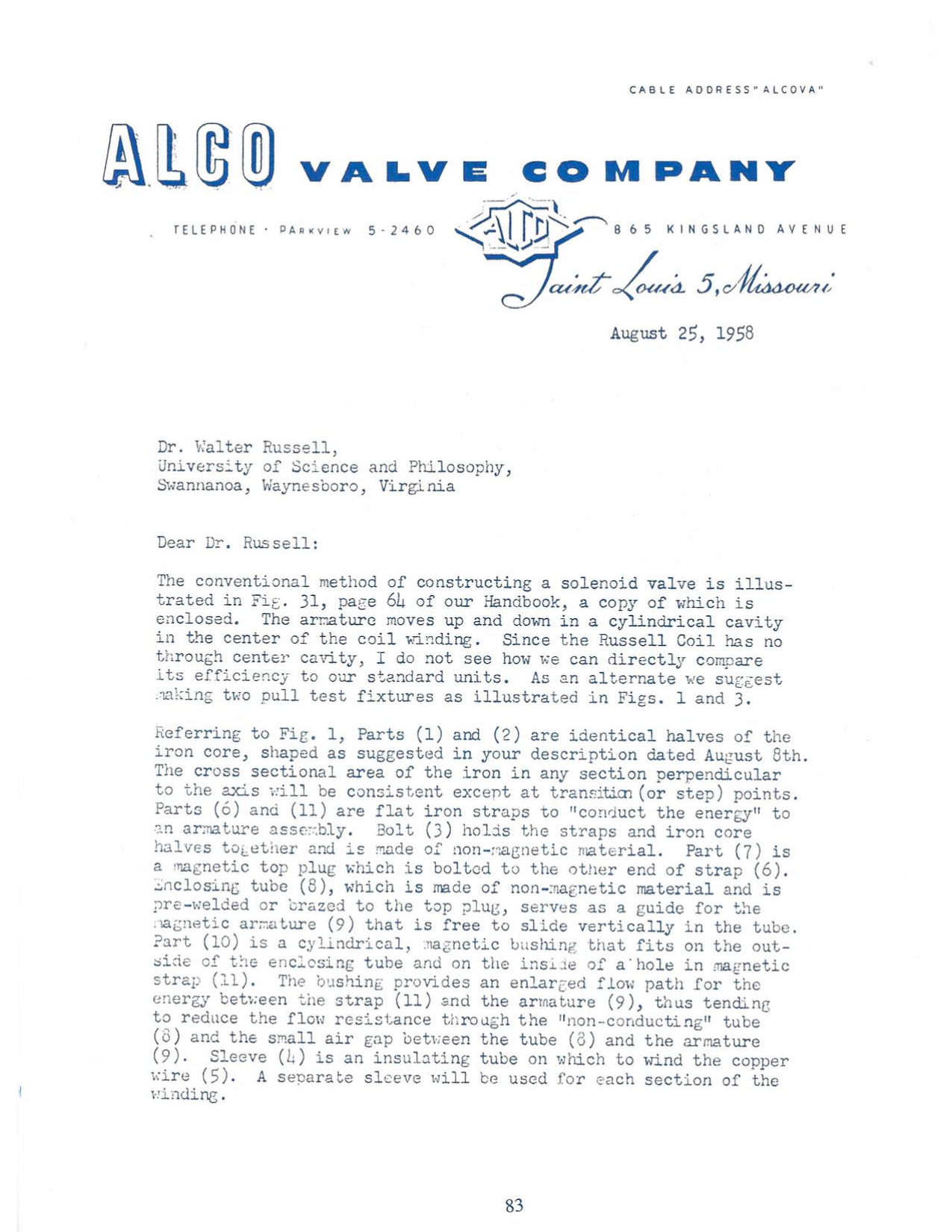
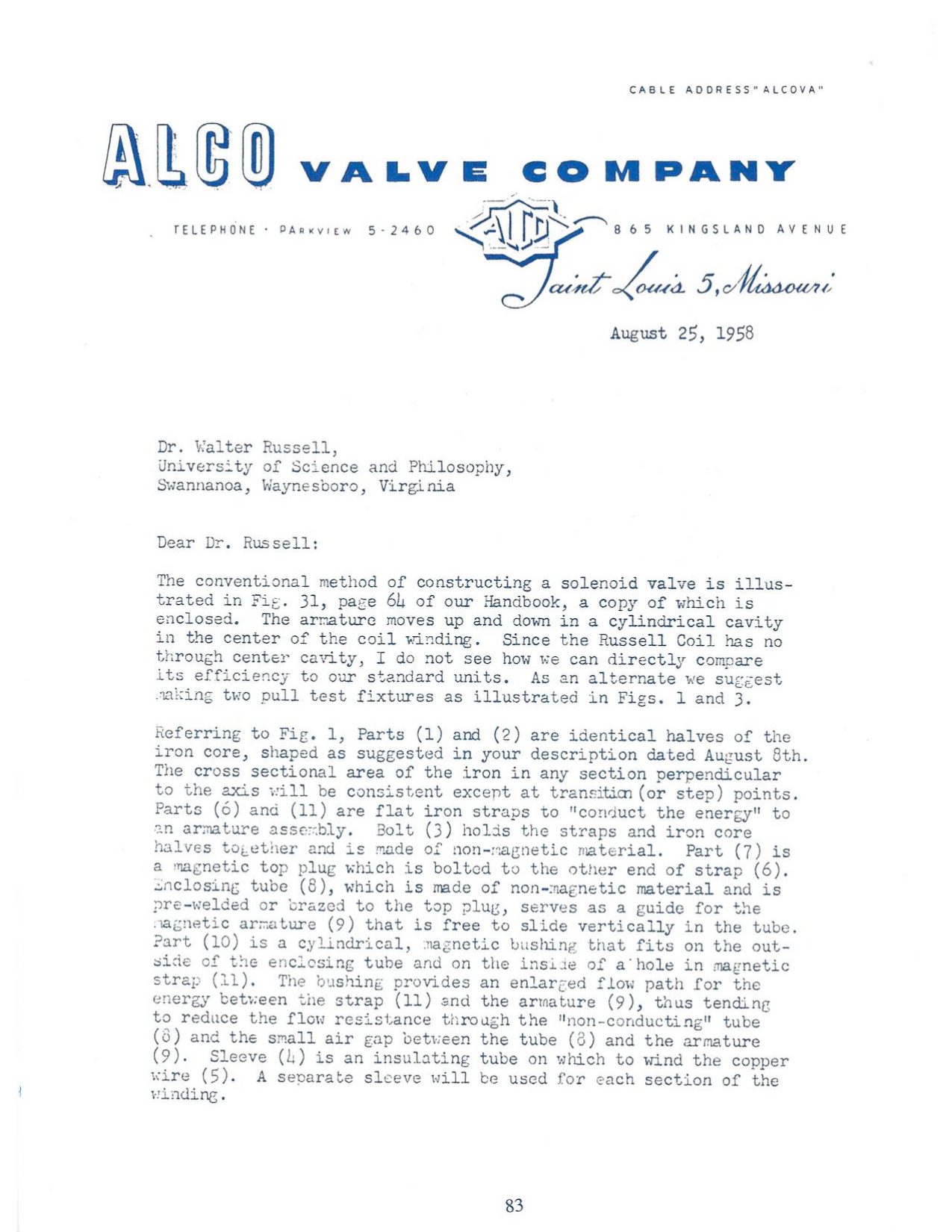
CABLE ADDRESS "ALCOVA"
ALCO VALVE COMPANY
TELEPHONE · PARKVIEW 5-2460          865 KINGSLAND AVENUE
Saint Louis 5, Missouri
August 25, 1958
Dr. Walter Russell,
University of Science and Philosophy,
Swannanoa, Waynesboro, Virginia
Dear Dr. Russell:
The conventional method of constructing a solenoid valve is illus-
trated in Fig. 31, page 64 of our Handbook, a copy of which is
enclosed. The armature moves up and down in a cylindrical cavity
in the center of the coil winding. Since the Russell Coil has no
through center cavity, I do not see how we can directly compare
its efficiency to our standard units. As an alternate we suggest
making two pull test fixtures as illustrated in Figs. 1 and 3.
Referring to Fig. 1, Parts (1) and (2) are identical halves of the
iron core, shaped as suggested in your description dated August 8th.
The cross sectional area of the iron in any section perpendicular
to the axis will be consistent except at transition (or step) points.
Parts (6) and (11) are flat iron straps to "conduct the energy" to
an armature assembly. Bolt (3) holds the straps and iron core
halves together and is made of non-magnetic material. Part (7) is
a magnetic top plug which is bolted to the other end of strap (6).
Enclosing tube (8), which is made of non-magnetic material and is
pre-welded or brazed to the top plug, serves as a guide for the
magnetic armature (9) that is free to slide vertically in the tube.
Part (10) is a cylindrical, magnetic bushing that fits on the out-
side of the enclosing tube and on the inside of a hole in magnetic
strap (11). The bushing provides an enlarged flow path for the
energy between the strap (11) and the armature (9), thus tending
to reduce the flow resistance through the "non-conducting" tube
(8) and the small air gap between the tube (8) and the armature
(9). Sleeve (4) is an insulating tube on which to wind the copper
wire (5). A separate sleeve will be used for each section of the
winding.
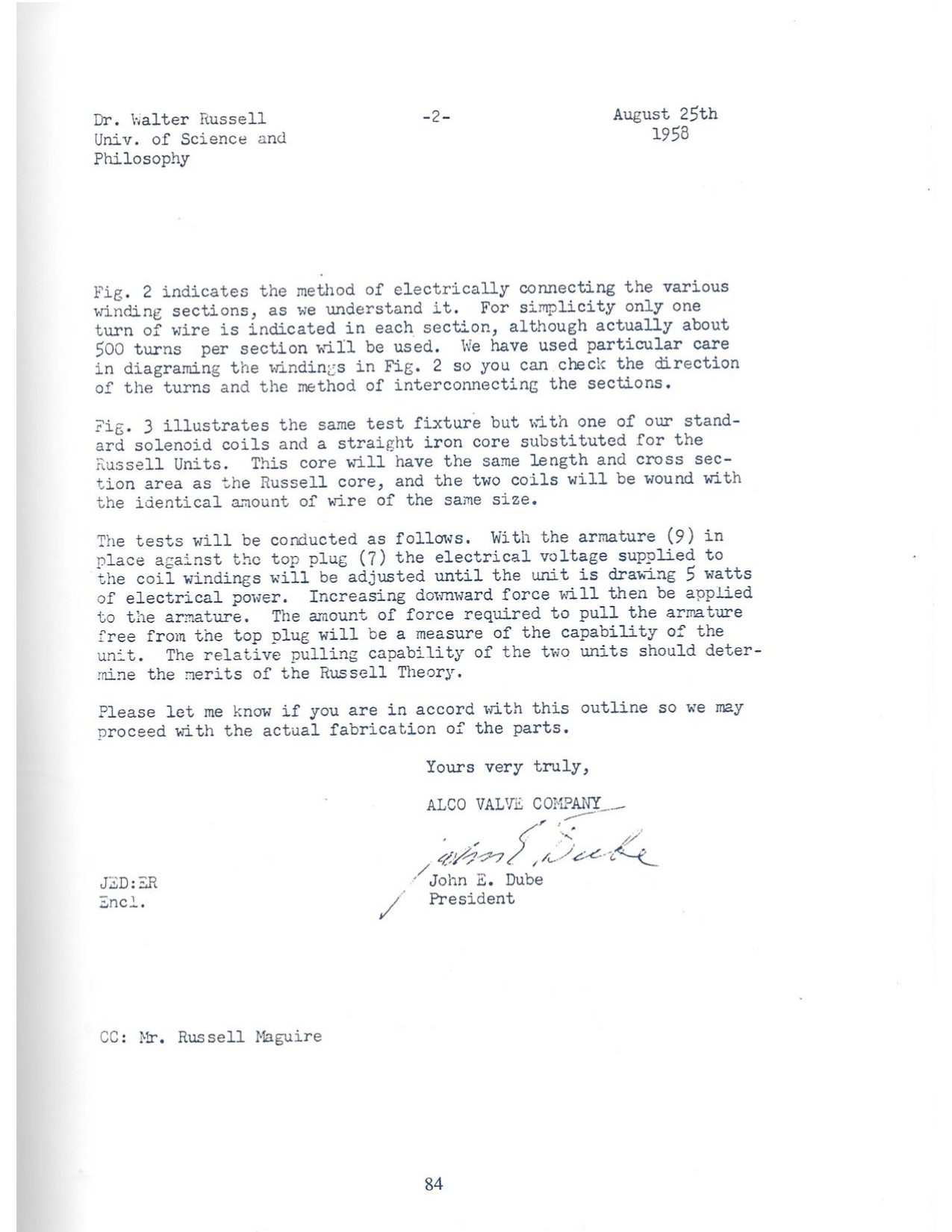
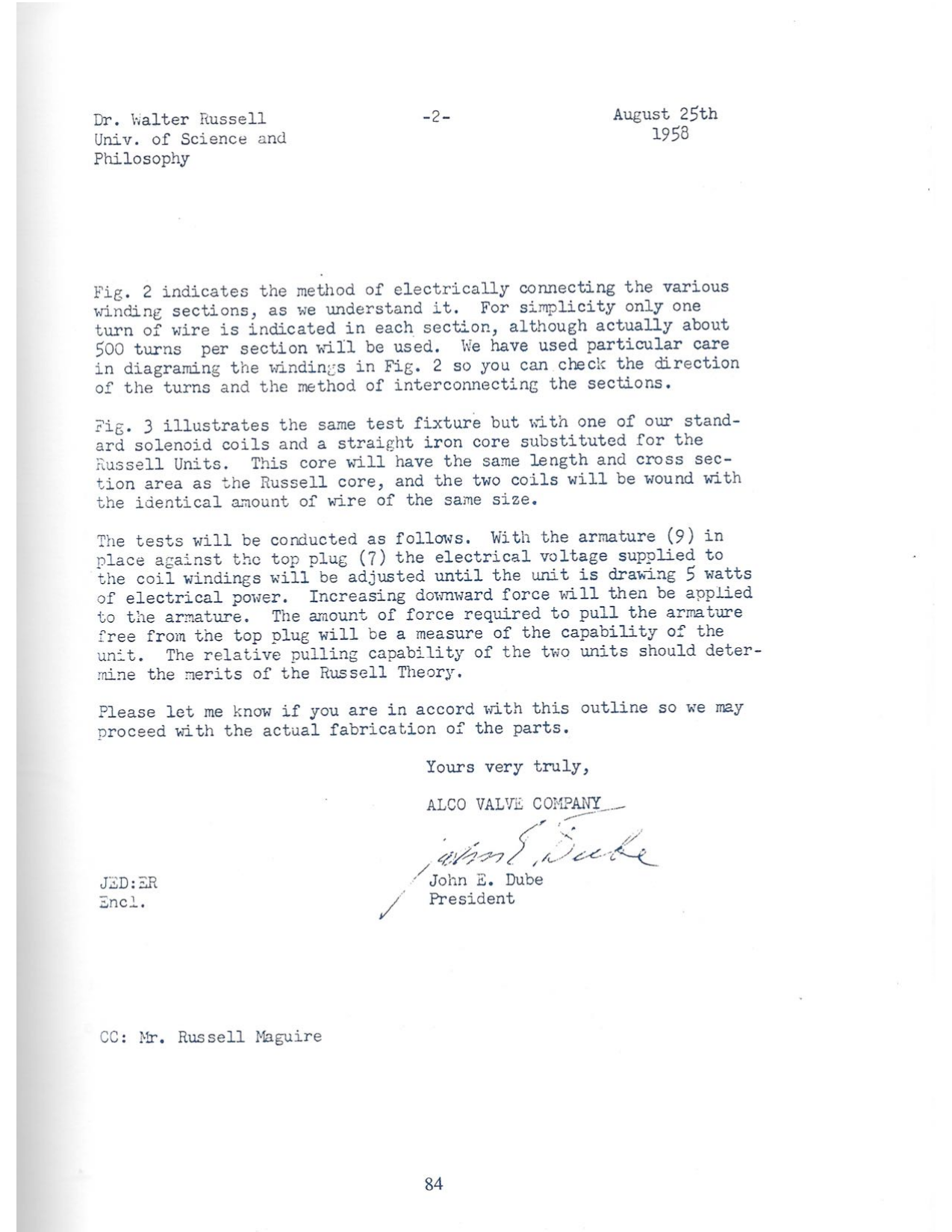
[page break — journal p. 84, letterhead continuation:]
Dr. Walter Russell,          -2-          August 25th
Univ. of Science and                      1958
Philosophy
Fig. 2 indicates the method of electrically connecting the various
winding sections, as we understand it. For simplicity only one
turn of wire is indicated in each section, although actually about
500 turns per section will be used. We have used particular care
in diagraming the windings in Fig. 2 so you can check the direction
of the turns and the method of interconnecting the sections.
Fig. 3 illustrates the same test fixture but with one of our stand-
ard solenoid coils and a straight iron core substituted for the
Russell Units. This core will have the same length and cross sec-
tion area as the Russell core, and the two coils will be wound with
the identical amount of wire of the same size.
The tests will be conducted as follows. With the armature (9) in
place against the top plug (7) the electrical voltage supplied to
the coil windings will be adjusted until the unit is drawing 5 watts
of electrical power. Increasing downward force will then be applied
to the armature. The amount of force required to pull the armature
free from the top plug will be a measure of the capability of the
unit. The relative pulling capability of the two units should deter-
mine the merits of the Russell Theory.
Please let me know if you are in accord with this outline so we may
proceed with the actual fabrication of the parts.
Yours very truly,
ALCO VALVE COMPANY
[signature: John E. Dube]
John E. Dube
President
JED:ER
Encl.
CC: Mr. Russell Maguire
Editorial notes
- This letter is a direct reply to Walter Russell's coil "description dated August 8th" (1958). This issue does not reprint that description.
- The test protocol described here is a constant 5-watt input with a measured breakaway pull force. Its results appear in Fig. 4 (journal p. 92). Fig. 4, though, records the run conditions as 24 VDC / 4.4 watts.
- Figs. 1, 2 and 3, which the letter references, appear on journal pp. 88, 89 and 90 respectively.
- This letter spells "Maguire" thus. The Russells' Aug 30 reply spells it "Maquire."
3. The Russells approve the plan
Walter and Lao Russell accept the protocol as outlined and ask for one design change, a through-hole for later transmutation work.
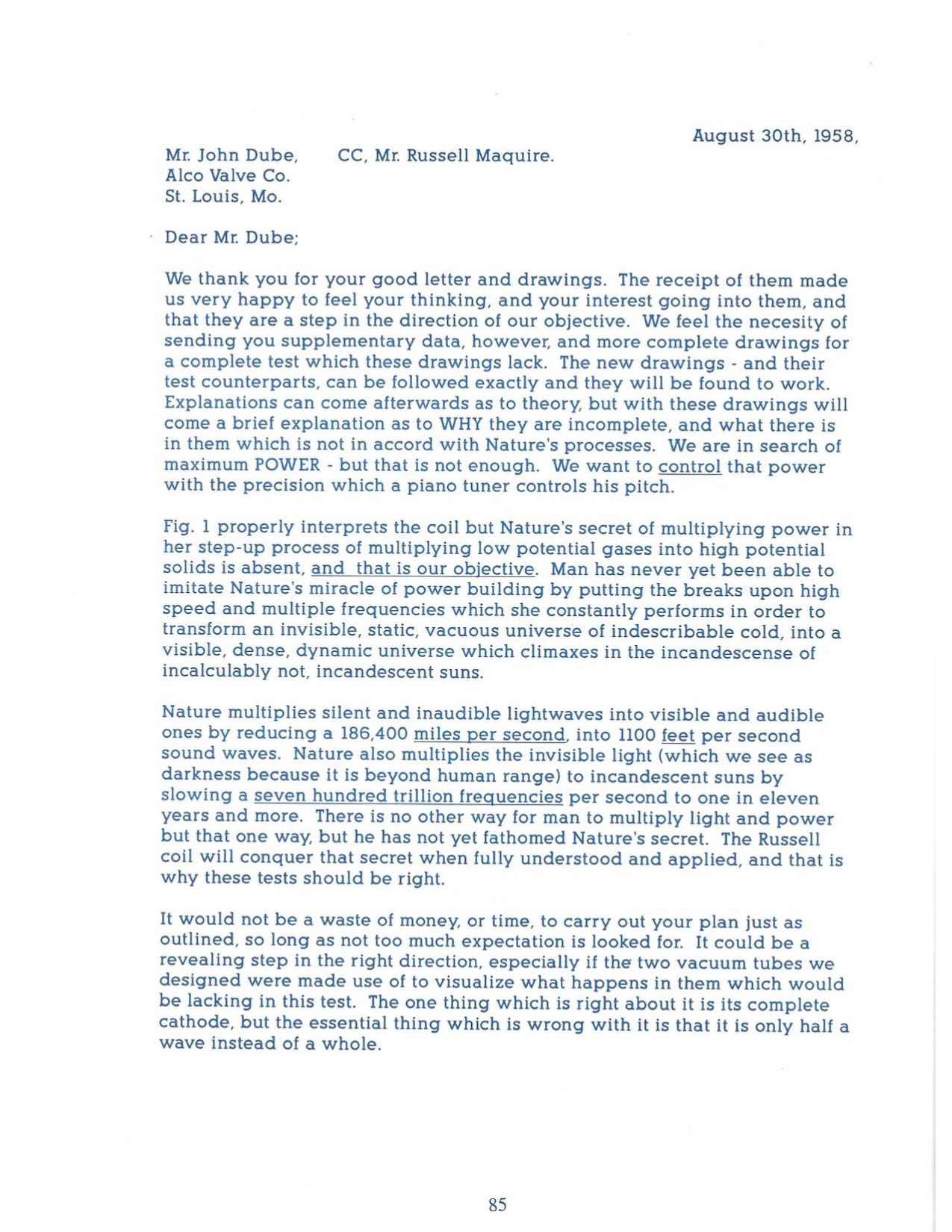
Note: this letter appears in the magazine as re-set type (serif font), not as a facsimile of the original typescript.
August 30th, 1958,
Mr. John Dube,          CC, Mr. Russell Maquire.
Alco Valve Co.
St. Louis, Mo.
Dear Mr. Dube;
We thank you for your good letter and drawings. The receipt of them made
us very happy to feel your thinking, and your interest going into them, and
that they are a step in the direction of our objective. We feel the necesity [sic] of
sending you supplementary data, however, and more complete drawings for
a complete test which these drawings lack. The new drawings - and their
test counterparts, can be followed exactly and they will be found to work.
Explanations can come afterwards as to theory, but with these drawings will
come a brief explanation as to WHY they are incomplete, and what there is
in them which is not in accord with Nature's processes. We are in search of
maximum POWER - but that is not enough. We want to control that power
with the precision which a piano tuner controls his pitch.
Fig. 1 properly interprets the coil but Nature's secret of multiplying power in
her step-up process of multiplying low potential gases into high potential
solids is absent, and that is our objective. Man has never yet been able to
imitate Nature's miracle of power building by putting the breaks [sic] upon high
speed and multiple frequencies which she constantly performs in order to
transform an invisible, static, vacuous universe of indescribable cold, into a
visible, dense, dynamic universe which climaxes in the incandescense [sic] of
incalculably not [sic — likely "hot"], incandescent suns.
Nature multiplies silent and inaudible lightwaves into visible and audible
ones by reducing a 186,400 miles per second, into 1100 feet per second
sound waves. Nature also multiplies the invisible light (which we see as
darkness because it is beyond human range) to incandescent suns by
slowing a seven hundred trillion frequencies per second to one in eleven
years and more. There is no other way for man to multiply light and power
but that one way, but he has not yet fathomed Nature's secret. The Russell
coil will conquer that secret when fully understood and applied, and that is
why these tests should be right.
It would not be a waste of money, or time, to carry out your plan just as
outlined, so long as not too much expectation is looked for. It could be a
revealing step in the right direction, especially if the two vacuum tubes we
designed were made use of to visualize what happens in them which would
be lacking in this test. The one thing which is right about it is its complete
cathode, but the essential thing which is wrong with it is that it is only half a
wave instead of a whole.
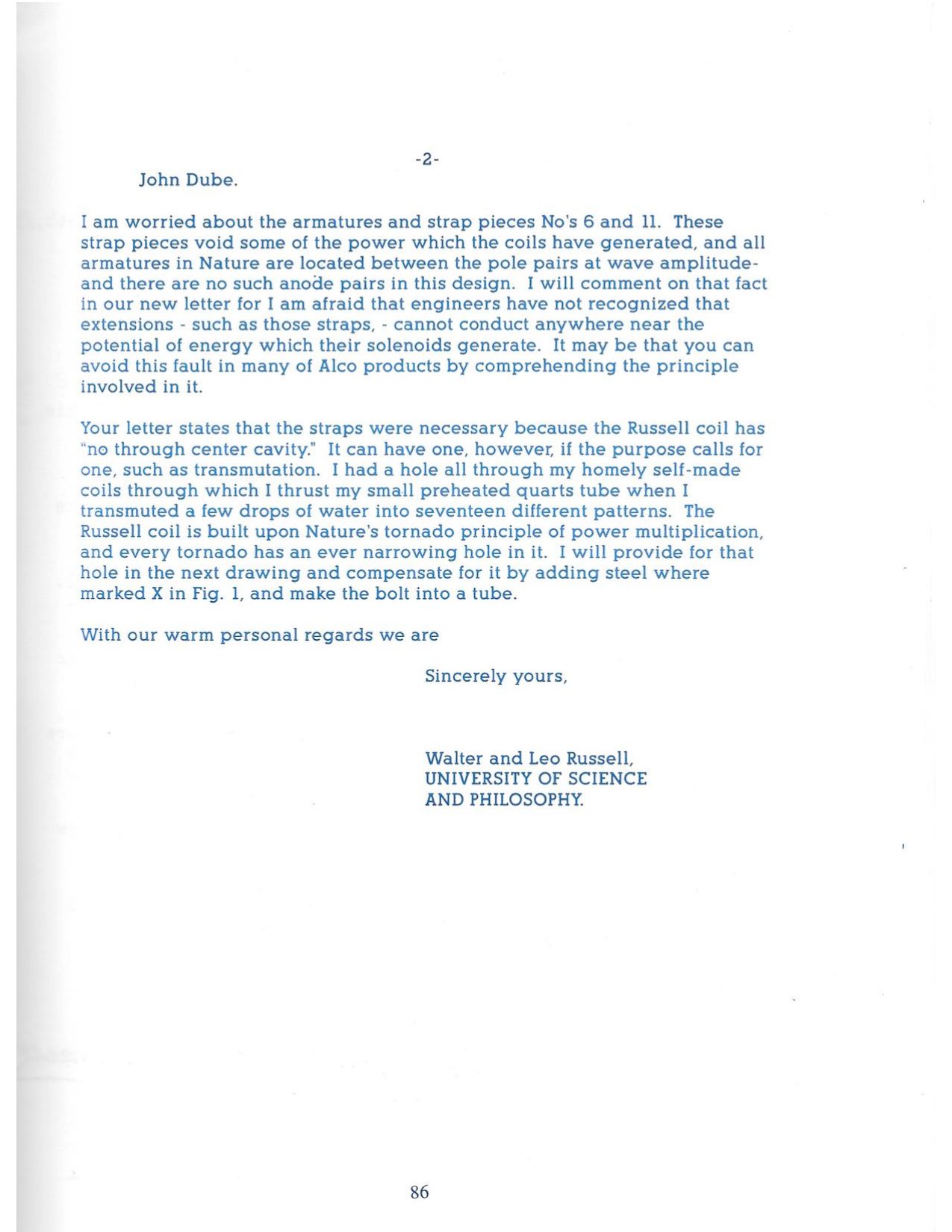
[page break — journal p. 86:]
          -2-
John Dube.
I am worried about the armatures and strap pieces No's 6 and 11. These
strap pieces void some of the power which the coils have generated, and all
armatures in Nature are located between the pole pairs at wave amplitude-
and there are no such anode pairs in this design. I will comment on that fact
in our new letter for I am afraid that engineers have not recognized that
extensions - such as those straps, - cannot conduct anywhere near the
potential of energy which their solenoids generate. It may be that you can
avoid this fault in many of Alco products by comprehending the principle
involved in it.
Your letter states that the straps were necessary because the Russell coil has
"no through center cavity." It can have one, however, if the purpose calls for
one, such as transmutation. I had a hole all through my homely self-made
coils through which I thrust my small preheated quarts [sic — quartz] tube when I
transmuted a few drops of water into seventeen different patterns. The
Russell coil is built upon Nature's tornado principle of power multiplication,
and every tornado has an ever narrowing hole in it. I will provide for that
hole in the next drawing and compensate for it by adding steel where
marked X in Fig. 1, and make the bolt into a tube.
With our warm personal regards we are
Sincerely yours,
          Walter and Leo Russell, [sic — Lao]
          UNIVERSITY OF SCIENCE
          AND PHILOSOPHY.
Editorial notes
- This letter replies to Dube's letter of Aug 25, 1958 (journal pp. 83–84). "No's 6 and 11" refer to the flat iron straps in Dube's Fig. 1/Fig. 3 fixtures.
- Russell's claim that he transmuted "a few drops of water into seventeen different patterns" with a quartz tube through the coil bore is his recurring account of his own earlier experiments.
- "anode pairs" (second paragraph, p. 86) appears as printed. Given the preceding sentence, it may be a typesetting error for "pole pairs."
- Several evident 1997 re-typesetting errors are preserved verbatim and tagged [sic]: "necesity," "breaks" (brakes), "incandescense," "not" (hot), "quarts" (quartz), "Leo" (Lao).
4. The prediction: a 40 to 60 percent advantage
Russell commits a number to paper before the coils exist: a 40 to 60 percent increase in "gravity power" for his coils over the conventional pair.
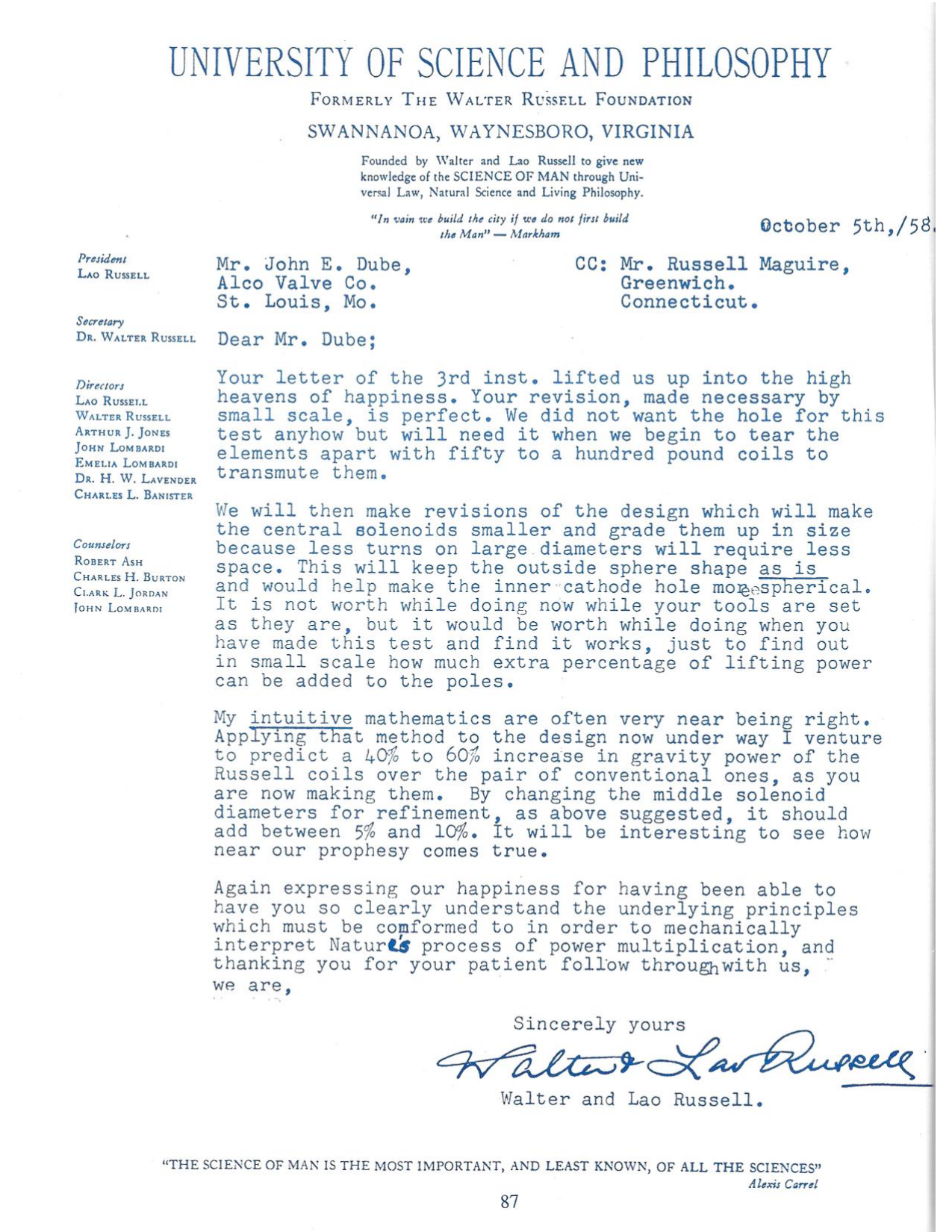
Note: the letter is reproduced in facsimile — University letterhead with a typed body and a joint autograph signature. Words underlined in the original typescript appear underlined here.
UNIVERSITY OF SCIENCE AND PHILOSOPHY
FORMERLY THE WALTER RUSSELL FOUNDATION
SWANNANOA, WAYNESBORO, VIRGINIA
Founded by Walter and Lao Russell to give new
knowledge of the SCIENCE OF MAN through Uni-
versal Law, Natural Science and Living Philosophy.
"In vain we build the city if we do not first build
the Man" — Markham
[left margin of letterhead:]
President: LAO RUSSELL
Secretary: DR. WALTER RUSSELL
Directors: LAO RUSSELL, WALTER RUSSELL, ARTHUR J. JONES, JOHN LOMBARDI,
EMELIA LOMBARDI, DR. H. W. LAVENDER, CHARLES L. BANISTER
Counselors: ROBERT ASH, CHARLES H. BURTON, CLARK L. JORDAN, JOHN LOMBARDI
October 5th,/58.
Mr. John E. Dube,          CC: Mr. Russell Maguire,
Alco Valve Co.                 Greenwich.
St. Louis, Mo.                 Connecticut.
Dear Mr. Dube;
Your letter of the 3rd inst. lifted us up into the high
heavens of happiness. Your revision, made necessary by
small scale, is perfect. We did not want the hole for this
test anyhow but will need it when we begin to tear the
elements apart with fifty to a hundred pound coils to
transmute them.
We will then make revisions of the design which will make
the central solenoids smaller and grade them up in size
because less turns on large diameters will require less
space. This will keep the outside sphere shape as is
and would help make the inner cathode hole more spherical.
It is not worth while doing now while your tools are set
as they are, but it would be worth while doing when you
have made this test and find it works, just to find out
in small scale how much extra percentage of lifting power
can be added to the poles.
My intuitive mathematics are often very near being right.
Applying that method to the design now under way I venture
to predict a 40% to 60% increase in gravity power of the
Russell coils over the pair of conventional ones, as you
are now making them. By changing the middle solenoid
diameters for refinement, as above suggested, it should
add between 5% and 10%. It will be interesting to see how
near our prophesy [sic] comes true.
Again expressing our happiness for having been able to
have you so clearly understand the underlying principles
which must be comformed [sic] to in order to mechanically
interpret Nature's process of power multiplication, and
thanking you for your patient follow through with us,
we are,
Sincerely yours
[signature: Walter & Lao Russell]
Walter and Lao Russell.
[letterhead footer:]
"THE SCIENCE OF MAN IS THE MOST IMPORTANT, AND LEAST KNOWN, OF ALL THE SCIENCES"
— Alexis Carrel
Editorial notes
- This letter replies to a Dube letter "of the 3rd inst." (October 3, 1958), which this issue does not reprint. That Dube letter evidently transmitted the revised test-unit drawings LO 8308-11 / LO 8308-12 dated Oct 2, 1958 (journal pp. 93–94). Those drawings delete the through-hole that Russell requested Aug 30.
- This puts Russell's quantitative prediction on record before the test: the Russell coils were to out-pull the conventional pair by 40–60%. The measured result (Fig. 4, journal p. 92, dated Nov 1958) shows that the step-diameter (Russell) coils pull less than the standard coils at every gap. This is the "Dube verdict."
- "comformed" and "prophesy" are preserved as in the facsimile typescript. In "patient follow through with us", the typescript drops the final h of "through" to subscript and runs it into "with" with no space ("througₕwith" — a slipped key). The transcript normalizes the spacing.
5. Dube reports the result
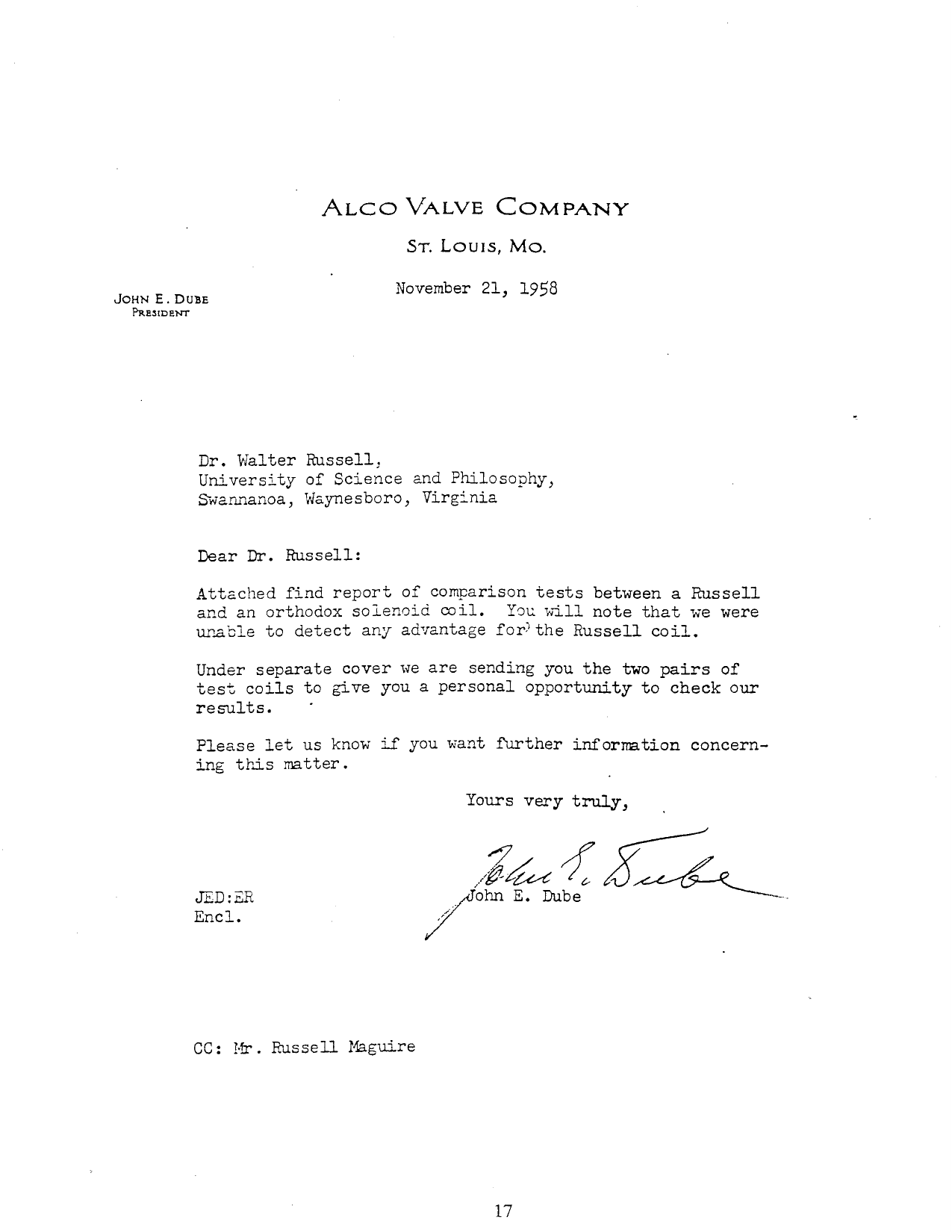
One sentence carries the verdict. Dube also returned both pairs of test coils so that Russell could check the measurements himself.
Conventions: the transcription is verbatim. [illegible] = unreadable. [word?] = uncertain reading.
ALCO VALVE COMPANY
ST. LOUIS, MO.
November 21, 1958
JOHN E. DUBE
PRESIDENT
Dr. Walter Russell,
University of Science and Philosophy,
Swannanoa, Waynesboro, Virginia
Dear Dr. Russell:
Attached find report of comparison tests between a Russell
and an orthodox solenoid coil.  You will note that we were
unable to detect any advantage for the Russell coil.
Under separate cover we are sending you the two pairs of
test coils to give you a personal opportunity to check our
results.
Please let us know if you want further information concern-
ing this matter.
Yours very truly,
[signature: John E. Dube]
John E. Dube
JED:ER
Encl.
CC: Mr. Russell Maguire
Editorial notes
- This is the cover letter for the "Report on Evaluation of Russell Coil" printed on journal pp. 18–19 (see v4n3_p18_evaluation_report.md).
- One sentence delivers the verdict: "we were unable to detect any advantage for the Russell coil." Dube also returned the physical test coils to Russell so that Russell could replicate the measurements himself. This was a notably fair-minded gesture.
- The CC to Russell Maguire (Greenwich, Conn.) identifies the financier/backer of the test program. Russell's Nov. 24, 1958 reply (journal pp. 20–22) is addressed to Maguire with a copy to Dube. This confirms Maguire as the sponsor who was "withdrawing" after the negative result.
6. Report on Evaluation of Russell Coil
The Alco engineering report: design, two tests, results, and three conclusions. It discloses the 4 percent resistance deviation that favors the Russell coil.
Conventions: the transcription is verbatim. [illegible] = unreadable. [word?] = uncertain reading. The left margin of the scan is cropped, which truncates the section labels. Square brackets supply the obvious reconstructions, e.g. [OBJ]ECT.
Journal p. 18 (PDF 21)
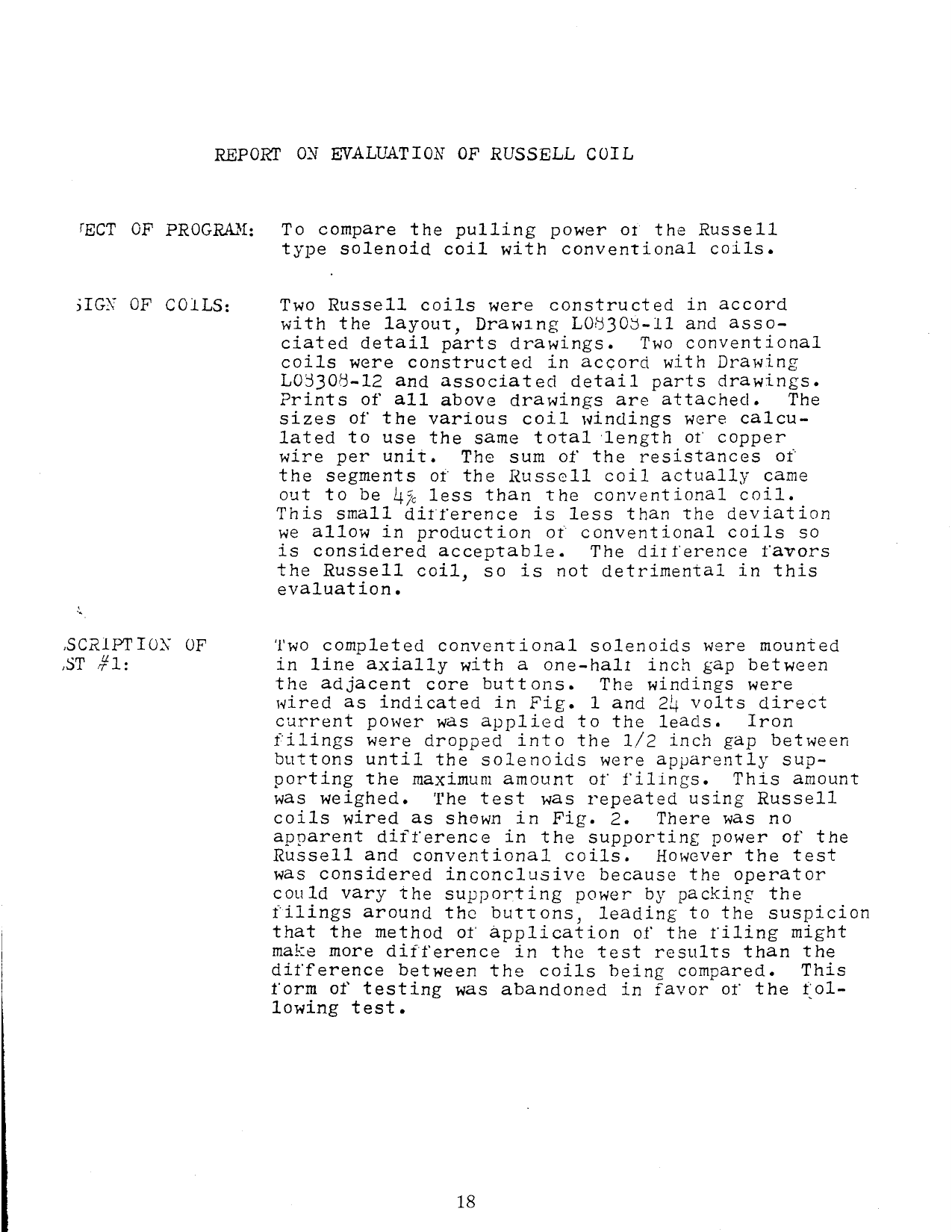
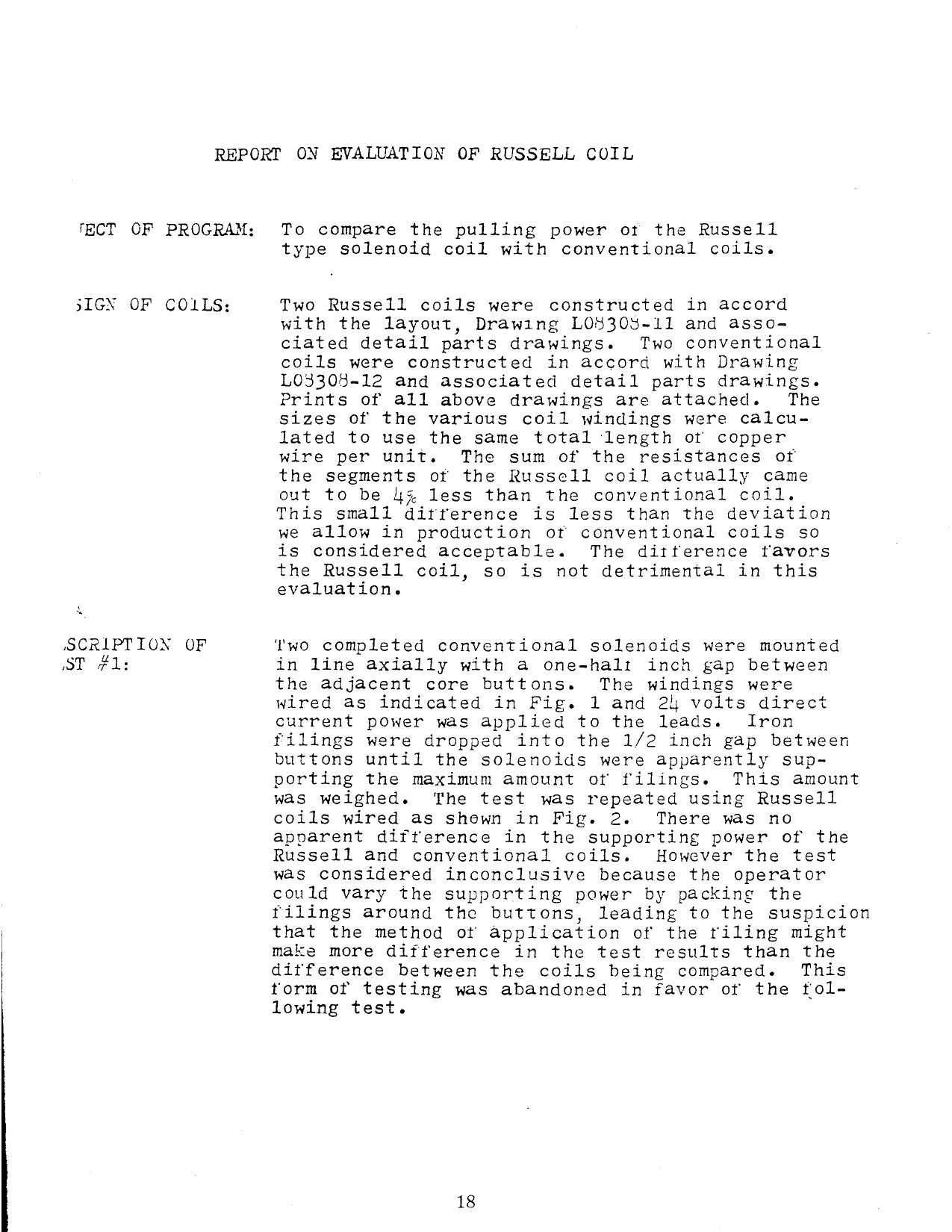
REPORT ON EVALUATION OF RUSSELL COIL
[OBJ]ECT OF PROGRAM:
To compare the pulling power of the Russell
type solenoid coil with conventional coils.
[DE]SIGN OF COILS:
Two Russell coils were constructed in accord
with the layout, Drawing L08308-11 and asso-
ciated detail parts drawings.  Two conventional
coils were constructed in accord with Drawing
L08308-12 and associated detail parts drawings.
Prints of all above drawings are attached.  The
sizes of the various coil windings were calcu-
lated to use the same total length of copper
wire per unit.  The sum of the resistances of
the segments of the Russell coil actually came
out to be 4% less than the conventional coil.
This small difference is less than the deviation
we allow in production of conventional coils so
is considered acceptable.  The difference favors
the Russell coil, so is not detrimental in this
evaluation.
[DE]SCRIPTION OF
[TE]ST #1:
Two completed conventional solenoids were mounted
in line axially with a one-half inch gap between
the adjacent core buttons.  The windings were
wired as indicated in Fig. 1 and 24 volts direct
current power was applied to the leads.  Iron
filings were dropped into the 1/2 inch gap between
buttons until the solenoids were apparently sup-
porting the maximum amount of filings.  This amount
was weighed.  The test was repeated using Russell
coils wired as shown in Fig. 2.  There was no
apparent difference in the supporting power of the
Russell and conventional coils.  However the test
was considered inconclusive because the operator
could vary the supporting power by packing the
filings around the buttons, leading to the suspicion
that the method of application of the filing might
make more difference in the test results than the
difference between the coils being compared.  This
form of testing was abandoned in favor of the fol-
lowing test.
Journal p. 19 (PDF 22)
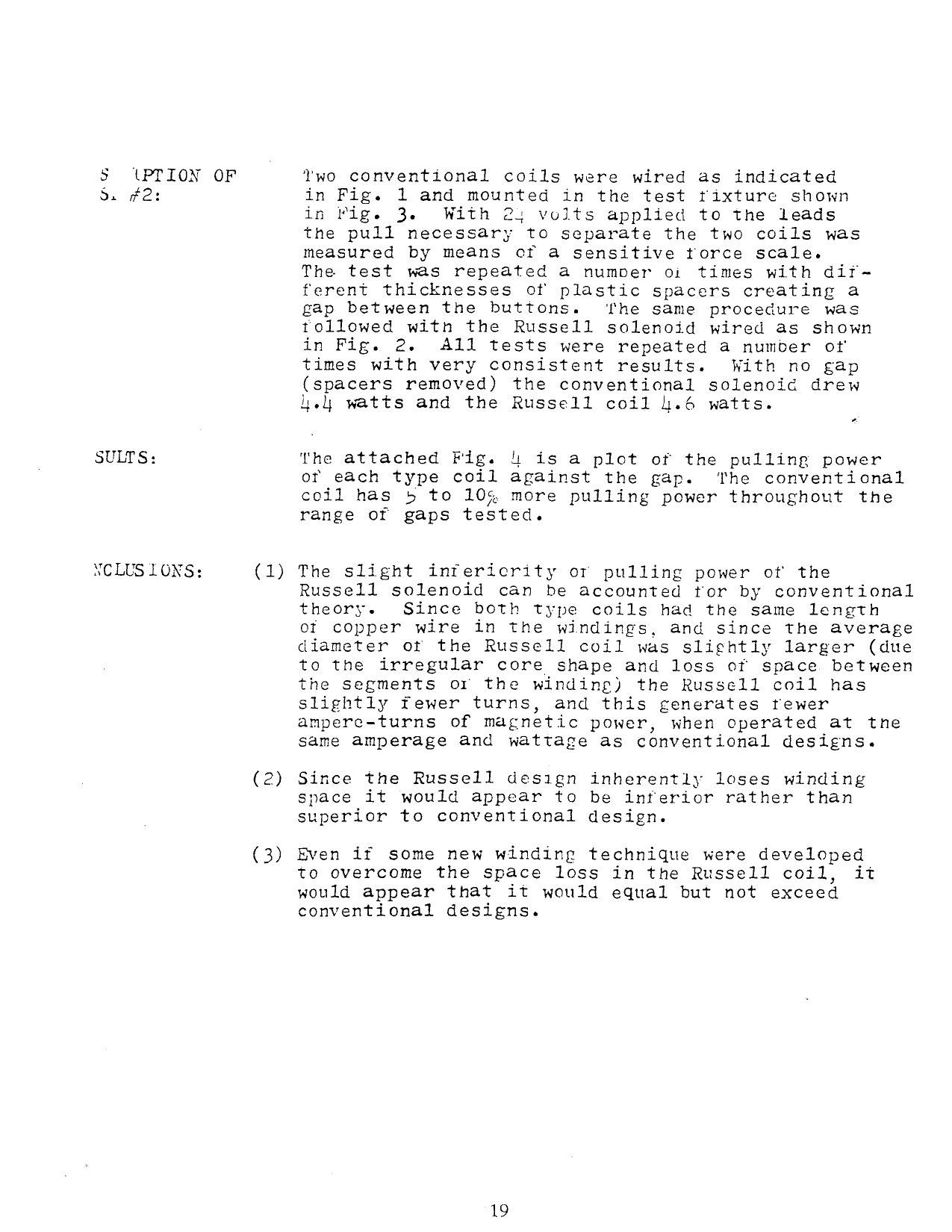
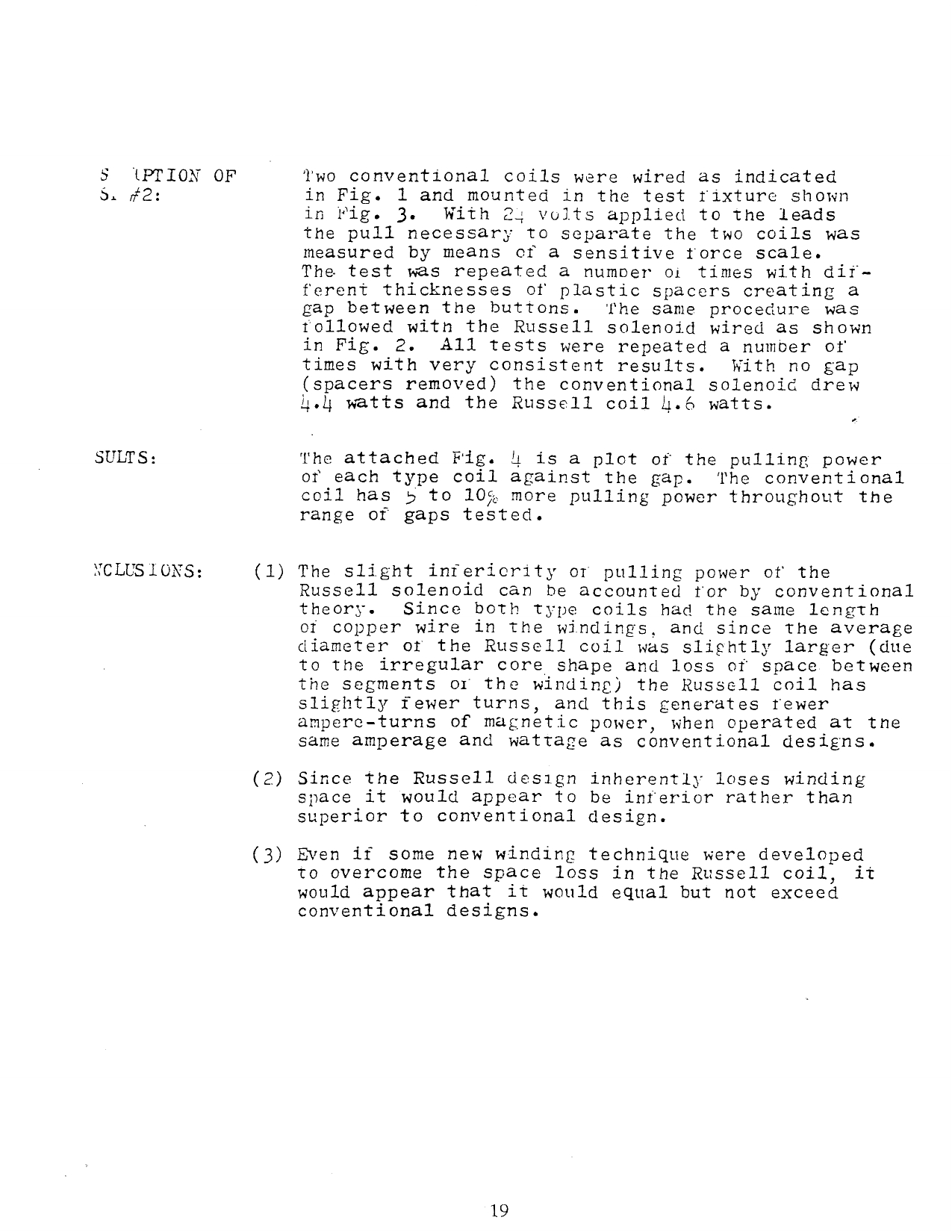
[DE]SCRIPTION OF
[TE]ST #2:
Two conventional coils were wired as indicated
in Fig. 1 and mounted in the test fixture shown
in Fig. 3.  With 24 volts applied to the leads
the pull necessary to separate the two coils was
measured by means of a sensitive force scale.
The test was repeated a number of times with dif-
ferent thicknesses of plastic spacers creating a
gap between the buttons.  The same procedure was
followed with the Russell solenoid wired as shown
in Fig. 2.  All tests were repeated a number of
times with very consistent results.  With no gap
(spacers removed) the conventional solenoid drew
4.4 watts and the Russell coil 4.6 watts.
[RE]SULTS:
The attached Fig. 4 is a plot of the pulling power
of each type coil against the gap.  The conventional
coil has 5 to 10% more pulling power throughout the
range of gaps tested.
[CO]NCLUSIONS:
(1) The slight inferiority of pulling power of the
    Russell solenoid can be accounted for by conventional
    theory.  Since both type coils had the same length
    of copper wire in the windings, and since the average
    diameter of the Russell coil was slightly larger (due
    to the irregular core shape and loss of space between
    the segments of the winding) the Russell coil has
    slightly fewer turns, and this generates fewer
    ampere-turns of magnetic power, when operated at the
    same amperage and wattage as conventional designs.
(2) Since the Russell design inherently loses winding
    space it would appear to be inferior rather than
    superior to conventional design.
(3) Even if some new winding technique were developed
    to overcome the space loss in the Russell coil, it
    would appear that it would equal but not exceed
    conventional designs.
Editorial notes
- Referenced but not reprinted: the report cites wiring diagrams Figs. 1–2, test fixture Fig. 3, and the pulling-power-vs-gap plot Fig. 4. It also cites layout drawings L08308-11 (Russell coil) / L08308-12 (conventional coil) with "associated detail parts drawings." The report says all of these are attached. None of these figures or drawings appear anywhere in this Fulcrum issue. We checked through PDF page 30 (journal p. 27). After journal p. 23 the issue switches to an unrelated 1923 "Russell Rent Mutualization Plan" reprint. Russell's P.S. of Nov. 24, 1958 asked Dube to keep copies and return the originals, so the drawings presumably went back to Swannanoa.
- Fig. 4 recovered in V5N1: Fulcrum Vol. 5, No. 1 reprints the pull-test graph (dated ~Nov 17, 1958, 24 VDC / 4.4 W), along with drawings LO 8308-11/-12 and detail parts LO 8308-101..-109 and -120..-122 (see transcripts/INDEX_v5n1.md). A calibrated read of that graph (±0.05 lb, gridline-calibrated; see schematics/README_schematics.md) gives four points per curve at gaps 0/.014/.028/.040 in: standard 5.09/2.62/1.72/1.32 lb, step 4.80/2.38/1.52/1.21 lb. The conventional-coil advantage is 6% at contact, 10% and 13% at the middle gaps, and 9% at .040 in. This matches the report's stated "5 to 10% more pulling power throughout the range of gaps tested" within reading uncertainty. An earlier approximate read of the graph endpoints (~2.1 vs ~1.4 lb, ≈50% spread) was a misread, and this note supersedes it. A power cross-check corroborates the data: 24²/131 Ω = 4.40 W and 24²/126 Ω = 4.57 W, which equal the report's 4.4 W and 4.6 W figures.
- Methodological quality: for 1958 industrial practice this is a clean controlled comparison. The units have equal copper length. The resistances match within production tolerance, and the 4% deviation favors the Russell coil — i.e., it biases the test toward the claim under test. The staff candidly flagged the operator-dependence of the abandoned first protocol. They repeated the trials and swept the gap. The confound they identify in Conclusion (1) (larger mean winding diameter → fewer turns → fewer ampere-turns) is textbook solenoid theory.
- Bottom line: the conventional coil is 5–10% stronger across all gaps. The Russell coil drew slightly more power at zero gap (4.6 W vs 4.4 W). That is, the Russell coil is worse on both counts.
7. The Russells concede
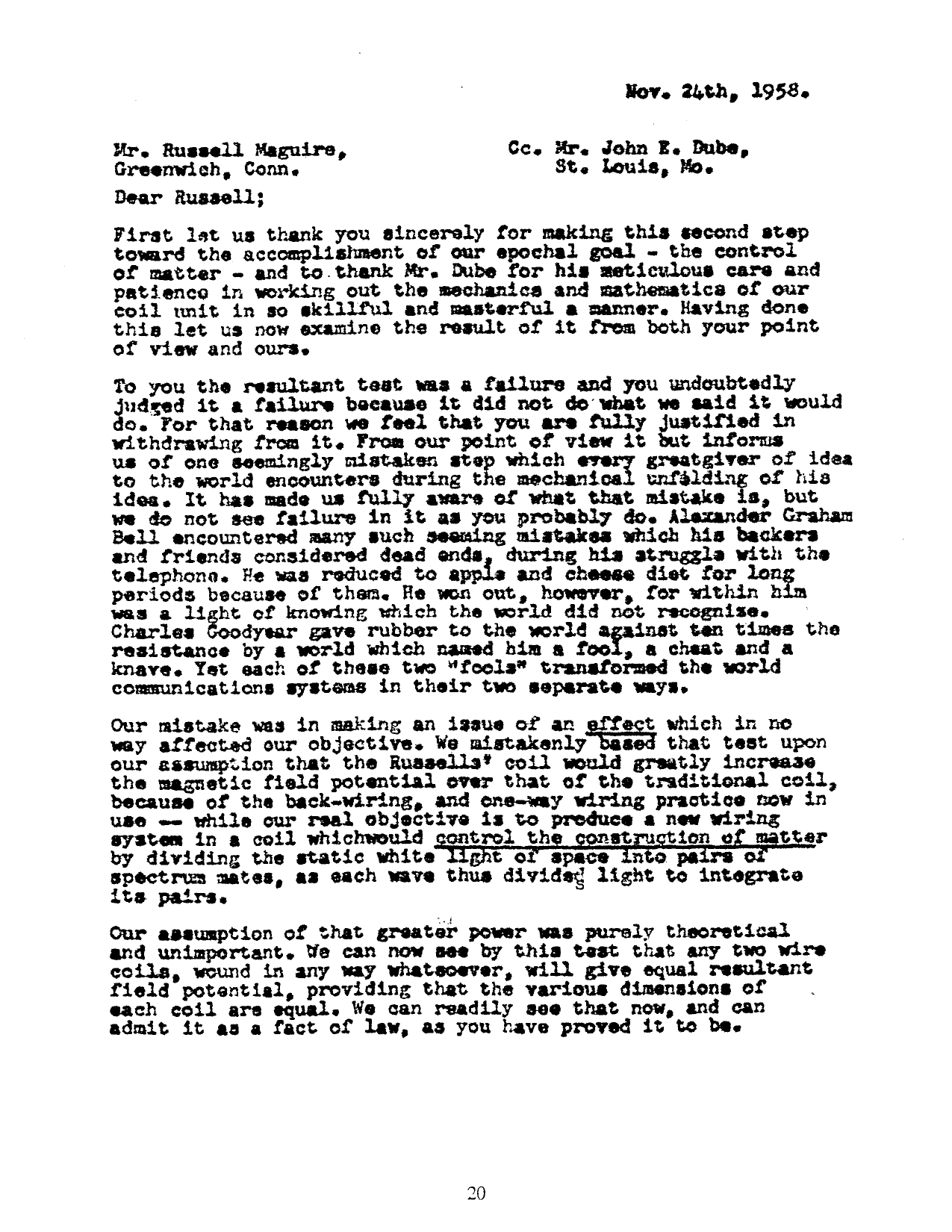
Three pages to the funder, with a copy to Dube. The concession "as a fact of law" stands beside the retreat: the martyrs, the moved goalposts, and the missile-defense claim.
Conventions: the transcription is verbatim. [illegible] = unreadable. [word?] = uncertain reading. Words underlined in the original appear underlined here. Typographical errors in the original are preserved, with [sic] added where they can confuse. Square brackets restore characters lost at the cropped/faded page edge.
Page 1 (journal p. 20 / PDF 23)
Nov. 24th, 1958.
Mr. Russell Maguire,          Cc. Mr. John E. Dube,
Greenwich, Conn.              St. Louis, Mo.
Dear Russell;
First let us thank you sincerely for making this second step
toward the accomplishment of our epochal goal - the control
of matter - and to thank Mr. Dube for his meticulous care and
patience in working out the mechanics and mathematics of our
coil unit in so skillful and masterful a manner. Having done
this let us now examine the result of it from both your point
of view and ours.
To you the resultant test was a failure and you undoubtedly
judged it a failure because it did not do what we said it would
do. For that reason we feel that you are fully justified in
withdrawing from it. From our point of view it but informs
us of one seemingly mistaken step which every greatgiver of idea
to the world encounters during the mechanical unfolding of his
idea. It has made us fully aware of what that mistake is, but
we do not see failure in it as you probably do. Alexander Graham
Bell encountered many such seeming mistakes which his backers
and friends considered dead ends, during his struggle with the
telephone. He was reduced to apple and cheese diet for long
periods because of them. He won out, however, for within him
was a light of knowing which the world did not recognize.
Charles Goodyear gave rubber to the world against ten times the
resistance by a world which named him a fool, a cheat and a
knave. Yet each of these two "fools" transformed the world
communications systems in their two separate ways.
Our mistake was in making an issue of an effect which in no
way affected our objective. We mistakenly based that test upon
our assumption that the Russells' coil would greatly increase
the magnetic field potential over that of the traditional coil,
because of the back-wiring, and one-way wiring practice now in
use -- while our real objective is to produce a new wiring
system in a coil whichwould [sic] control the construction of matter
by dividing the static white light of space into pairs of
spectrum mates, as each wave thus divide[s?] light to integrate
its pairs.
Our assumption of that greater power was purely theoretical
and unimportant. We can now see by this test that any two wire
coils, wound in any way whatsoever, will give equal resultant
field potential, providing that the various dimensions of
each coil are equal. We can readily see that now, and can
admit it as a fact of law, as you have proved it to be.
Page 2 (journal p. 21 / PDF 24)
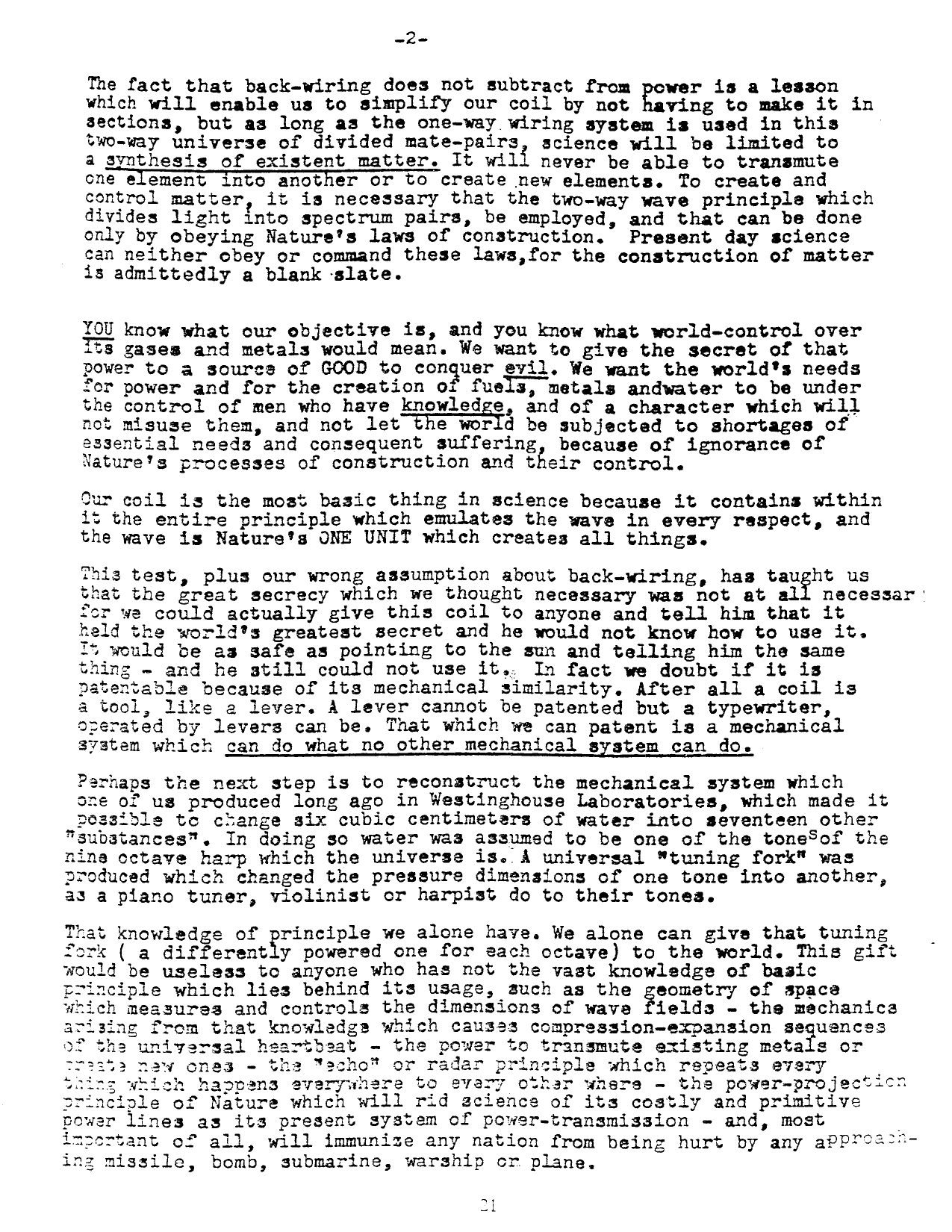
-2-
The fact that back-wiring does not subtract from power is a lesson
which will enable us to simplify our coil by not having to make it in
sections, but as long as the one-way wiring system is used in this
two-way universe of divided mate-pairs, science will be limited to
a synthesis of existent matter. It will never be able to transmute
one element into another or to create new elements. To create and
control matter, it is necessary that the two-way wave principle which
divides light into spectrum pairs, be employed, and that can be done
only by obeying Nature's laws of construction.  Present day science
can neither obey or command these laws,for [sic] the construction of matter
is admittedly a blank slate.
YOU know what our objective is, and you know what world-control over
its gases and metals would mean. We want to give the secret of that
power to a source of GOOD to conquer evil. We want the world's needs
for power and for the creation of fuels, metals andwater [sic] to be under
the control of men who have knowledge, and of a character which will
not misuse them, and not let the world be subjected to shortages of
essential needs and consequent suffering, because of ignorance of
Nature's processes of construction and their control.
Our coil is the most basic thing in science because it contains within
it the entire principle which emulates the wave in every respect, and
the wave is Nature's ONE UNIT which creates all things.
This test, plus our wrong assumption about back-wiring, has taught us
that the great secrecy which we thought necessary was not at all necessar[y]
for we could actually give this coil to anyone and tell him that it
held the world's greatest secret and he would not know how to use it.
It would be as safe as pointing to the sun and telling him the same
thing - and he still could not use it.  In fact we doubt if it is
patentable because of its mechanical similarity. After all a coil is
a tool, like a lever. A lever cannot be patented but a typewriter,
operated by levers can be. That which we can patent is a mechanical
system which can do what no other mechanical system can do.
Perhaps the next step is to reconstruct the mechanical system which
one of us produced long ago in Westinghouse Laboratories, which made it
possible to change six cubic centimeters of water into seventeen other
"substances". In doing so water was assumed to be one of the toneSof [sic] the
nine octave harp which the universe is. A universal "tuning fork" was
produced which changed the pressure dimensions of one tone into another,
as a piano tuner, violinist or harpist do to their tones.
That knowledge of principle we alone have. We alone can give that tuning
fork ( a differently powered one for each octave) to the world. This gift
would be useless to anyone who has not the vast knowledge of basic
principle which lies behind its usage, such as the geometry of space
which measures and controls the dimensions of wave fields - the mechanics
arising from that knowledge which causes compression-expansion sequences
of the universal heartbeat - the power to transmute existing metals or
create new ones - the "echo" or radar principle which repeats every
thing which happens everywhere to every other where - the power-projection
principle of Nature which will rid science of its costly and primitive
power lines as its present system of power-transmission - and, most
important of all, will immunize any nation from being hurt by any approach-
ing missile, bomb, submarine, warship or plane.
Page 3 (journal p. 22 / PDF 25)
-3-
CONCLUSION.
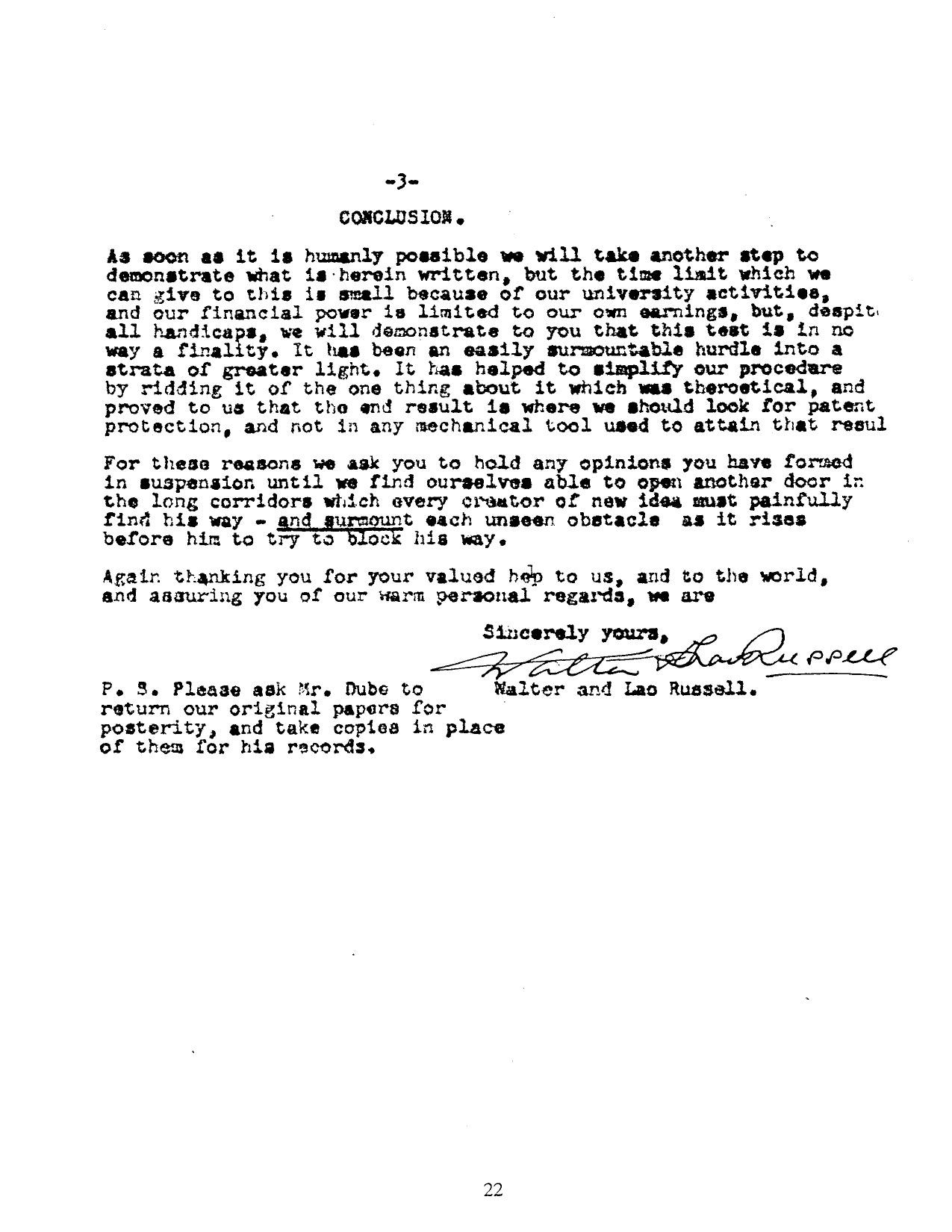
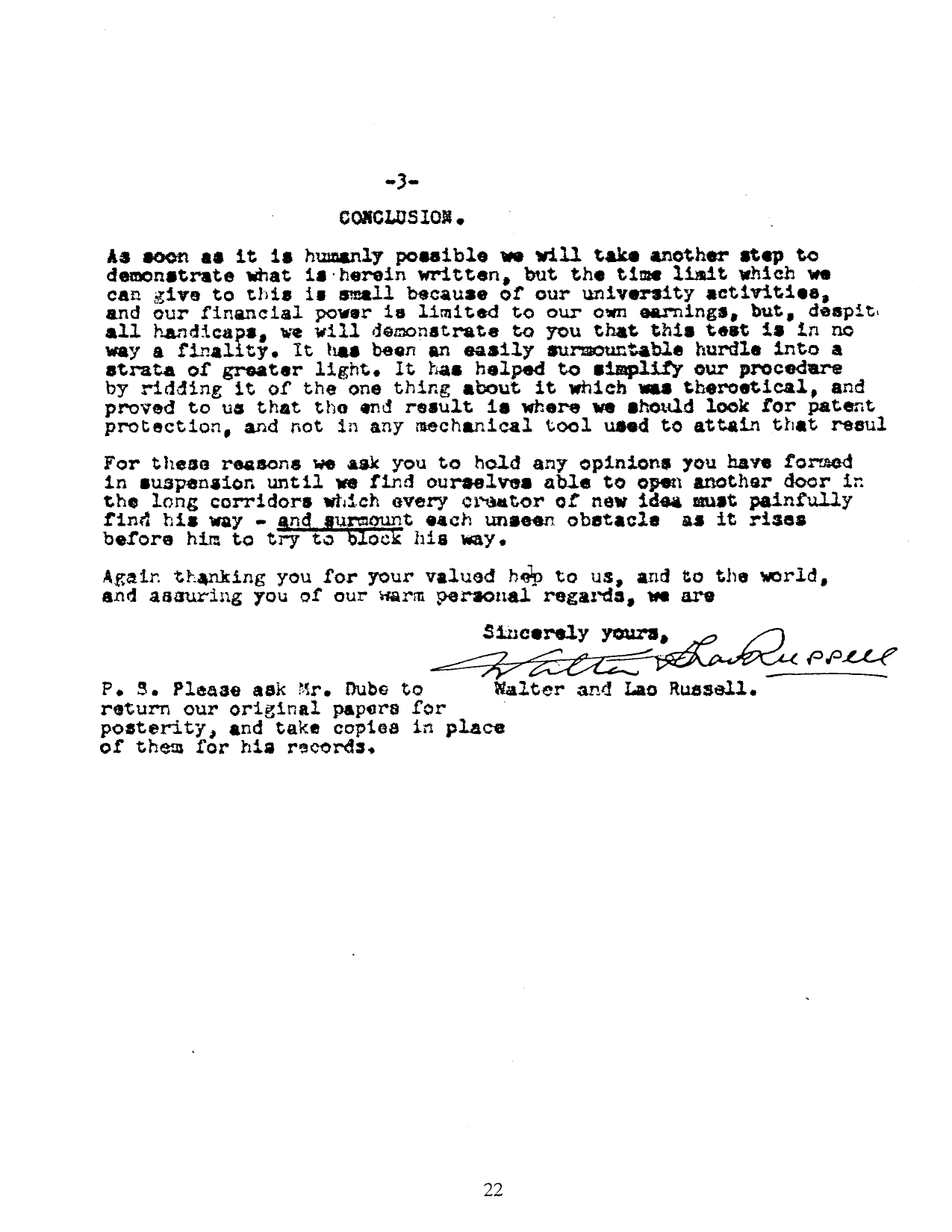
As soon as it is humanly possible we will take another step to
demonstrate what is herein written, but the time limit which we
can give to this is small because of our university activities,
and our financial power is limited to our own earnings, but, despit[e]
all handicaps, we will demonstrate to you that this test is in no
way a finality. It has been an easily surmountable hurdle into a
strata of greater light. It has helped to simplify our procedure
by ridding it of the one thing about it which was theroetical [sic], and
proved to us that the end result is where we should look for patent
protection, and not in any mechanical tool used to attain that resul[t]
For these reasons we ask you to hold any opinions you have formed
in suspension until we find ourselves able to open another door in
the long corridors which every creator of new idea must painfully
find his way - and surmount each unseen obstacle  as it rises
before him to try to block his way.
Again thanking you for your valued help to us, and to the world,
and assuring you of our warm personal regards, we are
Sincerely yours,
[signature: Walter and Lao Russell]
Walter and Lao Russell.
P. S. Please ask Mr. Dube to
return our original papers for
posterity, and take copies in place
of them for his records.
Editorial notes
- The key concession (p. 1, ¶4–5): the Russells accept the null result unreservedly — "any two wire coils, wound in any way whatsoever, will give equal resultant field potential, providing that the various dimensions of each coil are equal. We can readily see that now, and can admit it as a fact of law, as you have proved it to be." The 1996 editor quotes this sentence on journal p. 23.
- The reframe: the letter concedes the effect (greater power). It then pivots to claim that the coil's real purpose was always to "control the construction of matter" — transmutation, not output — and it reclassifies the power claim as "purely theoretical and unimportant." The comparisons to Bell and Goodyear, the geopolitical stakes (GOOD vs evil, missile immunity), and the Westinghouse water-transmutation story all serve this pivot.
- Secrecy reversal: the test convinced them that "the great secrecy which we thought necessary was not at all necessar[y]". This is directly relevant to community folklore about Russell's secret knowledge. Here Russell himself says they could give the coil to anyone safely.
- "whichwould", "andwater", "laws,for", "theroetical", "toneSof" are run-together or slipped-key typos preserved as typed in the original. "greatgiver" is one word in the original. The extra space in "obstacle as" (p. 3) reflects the typing.
- The letter treats Maguire's withdrawal as an accomplished fact ("you are fully justified in withdrawing from it"). No further Alco/Maguire test round is known from this issue.
8. The 1996 editor's note
USP's editor states why he printed the file, asks that the concession appear in future editions of the Home Study Course, and reports a second negative result on the Unit 11 lens bank.
Conventions: the transcription is verbatim. The two-column page is transcribed in reading order. [illegible] = unreadable. [word?] = uncertain reading. Titles italicized in the original (Home Study Course, HSC, Fulcrum) are rendered in italics. Words underlined in the original appear underlined here.
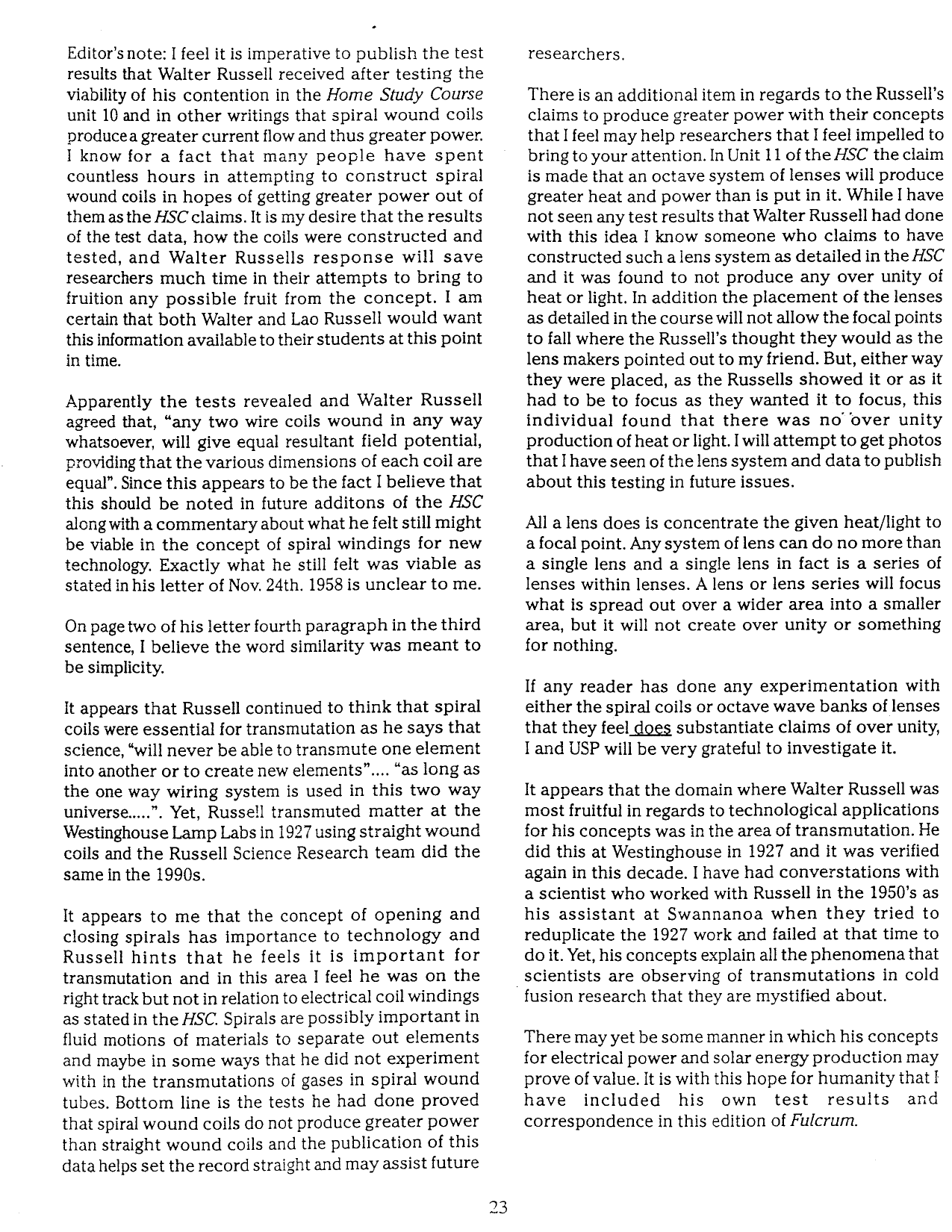
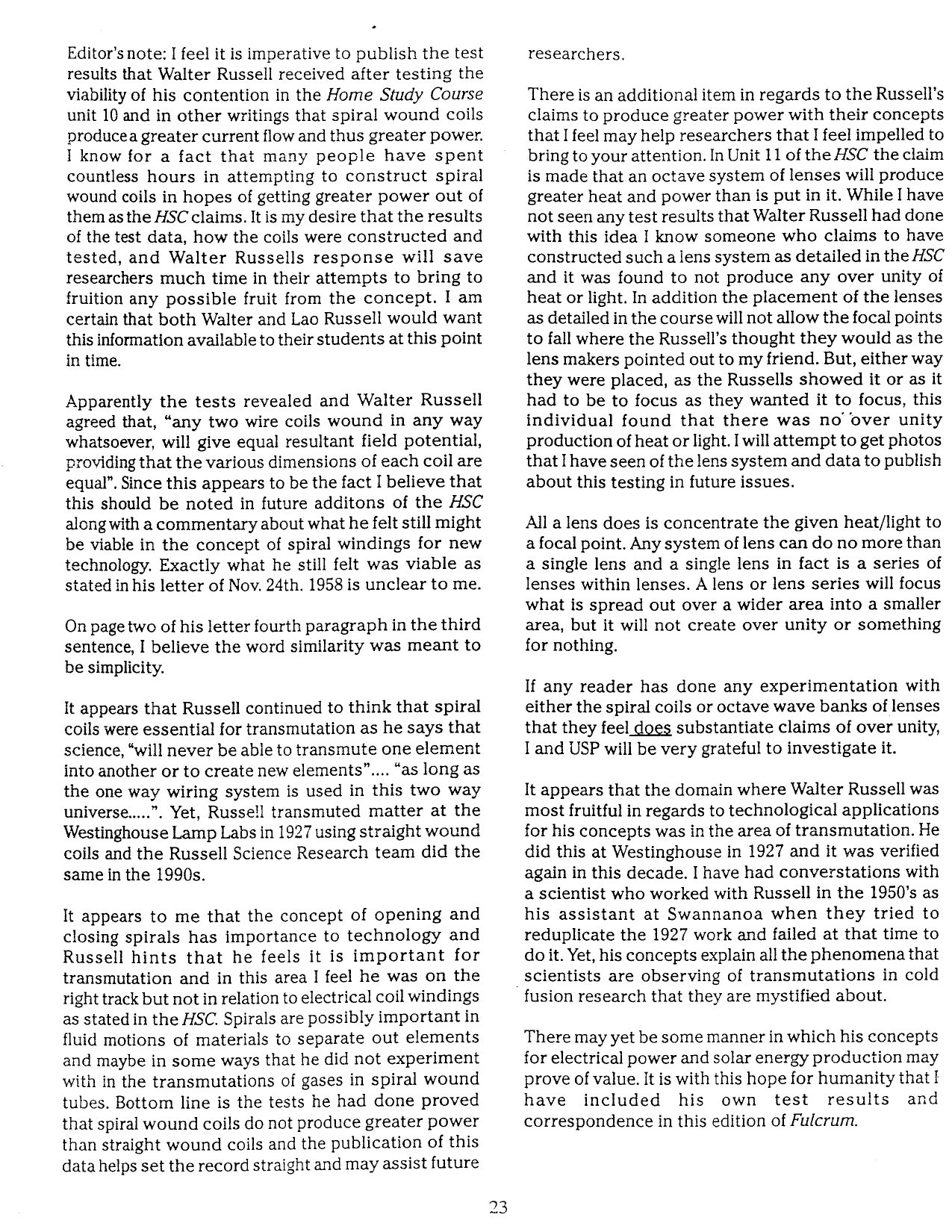
Editor's note: I feel it is imperative to publish the test
results that Walter Russell received after testing the
viability of his contention in the Home Study Course
unit 10 and in other writings that spiral wound coils
produce a greater current flow and thus greater power.
I know for a fact that many people have spent
countless hours in attempting to construct spiral
wound coils in hopes of getting greater power out of
them as the HSC claims. It is my desire that the results
of the test data, how the coils were constructed and
tested, and Walter Russells response will save
researchers much time in their attempts to bring to
fruition any possible fruit from the concept. I am
certain that both Walter and Lao Russell would want
this information available to their students at this point
in time.
Apparently the tests revealed and Walter Russell
agreed that, "any two wire coils wound in any way
whatsoever, will give equal resultant field potential,
providing that the various dimensions of each coil are
equal". Since this appears to be the fact I believe that
this should be noted in future additons [sic] of the HSC
along with a commentary about what he felt still might
be viable in the concept of spiral windings for new
technology. Exactly what he still felt was viable as
stated in his letter of Nov. 24th. 1958 is unclear to me.
On page two of his letter fourth paragraph in the third
sentence, I believe the word similarity was meant to
be simplicity.
It appears that Russell continued to think that spiral
coils were essential for transmutation as he says that
science, "will never be able to transmute one element
into another or to create new elements".... "as long as
the one way wiring system is used in this two way
universe.....". Yet, Russell transmuted matter at the
Westinghouse Lamp Labs in 1927 using straight wound
coils and the Russell Science Research team did the
same in the 1990s.
It appears to me that the concept of opening and
closing spirals has importance to technology and
Russell hints that he feels it is important for
transmutation and in this area I feel he was on the
right track but not in relation to electrical coil windings
as stated in the HSC. Spirals are possibly important in
fluid motions of materials to separate out elements
and maybe in some ways that he did not experiment
with in the transmutations of gases in spiral wound
tubes. Bottom line is the tests he had done proved
that spiral wound coils do not produce greater power
than straight wound coils and the publication of this
data helps set the record straight and may assist future
researchers.
There is an additional item in regards to the Russell's
claims to produce greater power with their concepts
that I feel may help researchers that I feel impelled to
bring to your attention. In Unit 11 of the HSC the claim
is made that an octave system of lenses will produce
greater heat and power than is put in it. While I have
not seen any test results that Walter Russell had done
with this idea I know someone who claims to have
constructed such a lens system as detailed in the HSC
and it was found to not produce any over unity of
heat or light. In addition the placement of the lenses
as detailed in the course will not allow the focal points
to fall where the Russell's thought they would as the
lens makers pointed out to my friend. But, either way
they were placed, as the Russells showed it or as it
had to be to focus as they wanted it to focus, this
individual found that there was no over unity
production of heat or light. I will attempt to get photos
that I have seen of the lens system and data to publish
about this testing in future issues.
All a lens does is concentrate the given heat/light to
a focal point. Any system of lens can do no more than
a single lens and a single lens in fact is a series of
lenses within lenses. A lens or lens series will focus
what is spread out over a wider area into a smaller
area, but it will not create over unity or something
for nothing.
If any reader has done any experimentation with
either the spiral coils or octave wave banks of lenses
that they feel does substantiate claims of over unity,
I and USP will be very grateful to investigate it.
It appears that the domain where Walter Russell was
most fruitful in regards to technological applications
for his concepts was in the area of transmutation. He
did this at Westinghouse in 1927 and it was verified
again in this decade. I have had converstations [sic] with
a scientist who worked with Russell in the 1950's as
his assistant at Swannanoa when they tried to
reduplicate the 1927 work and failed at that time to
do it. Yet, his concepts explain all the phenomena that
scientists are observing of transmutations in cold
fusion research that they are mystified about.
There may yet be some manner in which his concepts
for electrical power and solar energy production may
prove of value. It is with this hope for humanity that I
have included his own test results and correspondence
in this edition of Fulcrum.
Editorial notes
- This is remarkable editorial candor from within the Russell organization itself. USP's own journal states the 1958 tests "proved that spiral wound coils do not produce greater power than straight wound coils". It urges USP to correct future HSC editions. It also debunks the Unit 11 over-unity lens claim with an independent builder's negative result.
- The editor's internal contradiction is worth noting. He accepts the coil debunking. At the same time he asserts as fact that Russell "transmuted matter at the Westinghouse Lamp Labs in 1927" and that "the Russell Science Research team did the same in the 1990s". He also relays that Russell's own 1950s assistant failed to reduplicate the 1927 work.
- The suggested emendation ("similarity" → "simplicity") refers to the sentence "we doubt if it is patentable because of its mechanical similarity" on p. 2 of Russell's letter. Arguably "similarity" reads fine in context (similarity to existing coils).
- The 1927 Westinghouse claim referenced here corresponds to Russell's "six cubic centimeters of water into seventeen other substances" story in the Nov. 24 letter.
9. The 1997 editor's introduction
The introduction to the 19 pages of engineering drawings reprinted in this issue.
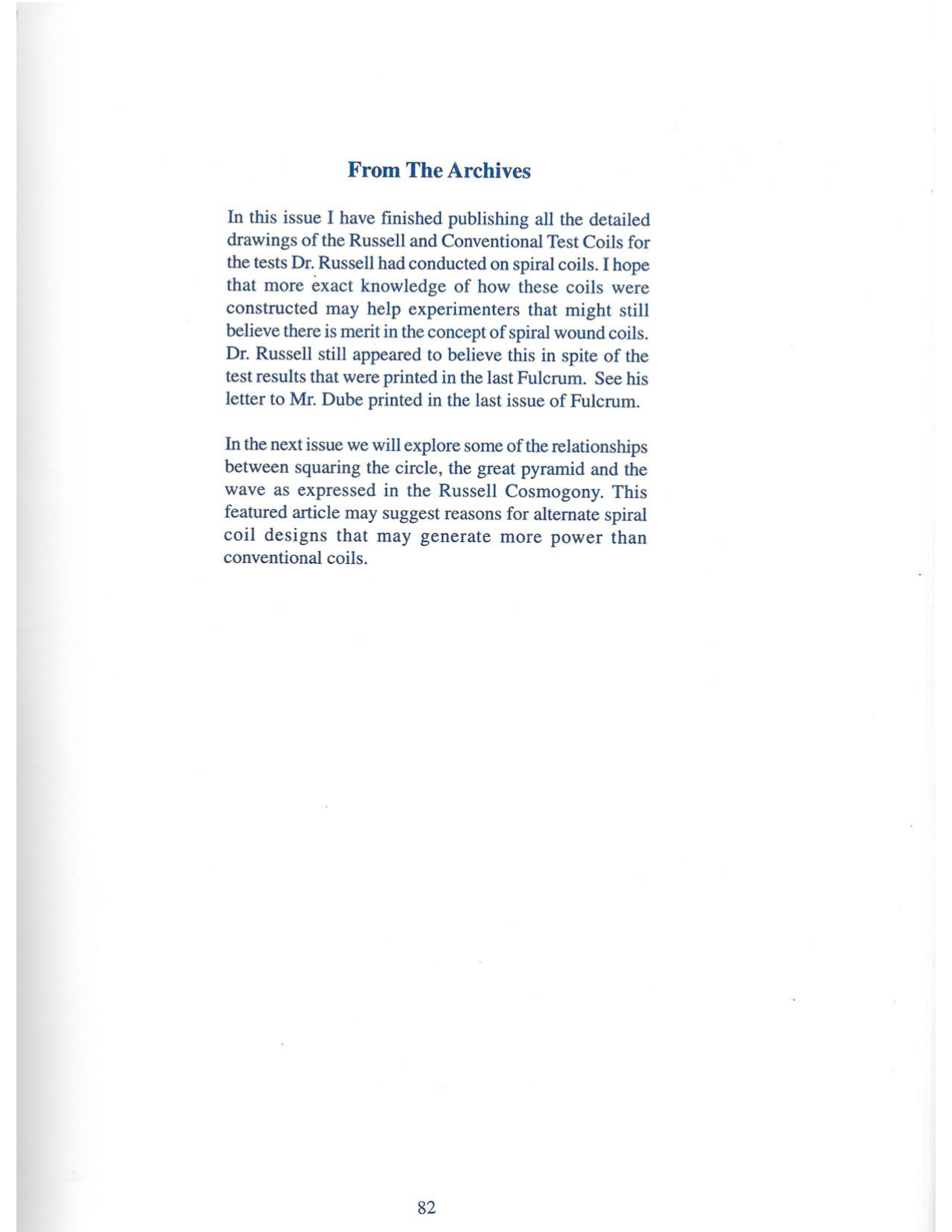
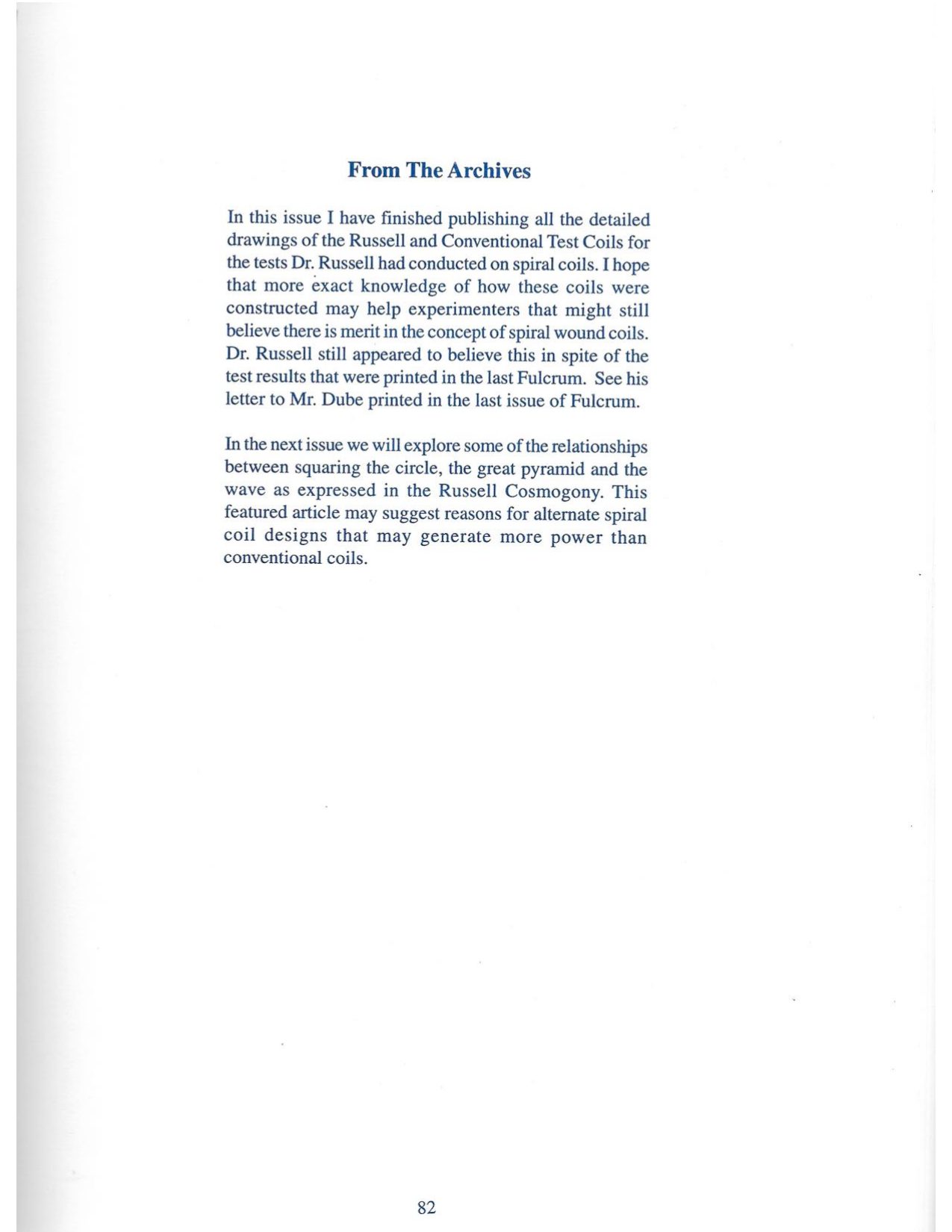
From The Archives
In this issue I have finished publishing all the detailed
drawings of the Russell and Conventional Test Coils for
the tests Dr. Russell had conducted on spiral coils. I hope
that more exact knowledge of how these coils were
constructed may help experimenters that might still
believe there is merit in the concept of spiral wound coils.
Dr. Russell still appeared to believe this in spite of the
test results that were printed in the last Fulcrum. See his
letter to Mr. Dube printed in the last issue of Fulcrum.
In the next issue we will explore some of the relationships
between squaring the circle, the great pyramid and the
wave as expressed in the Russell Cosmogony. This
featured article may suggest reasons for alternate spiral
coil designs that may generate more power than
conventional coils.
Editorial notes
- This intro confirms that the V5N1 section continues (and completes) the drawing set begun in Fulcrum V4N3. The previous issue (V4N3) printed the test results and Russell's post-test letter to Dube.
- The editor's phrase "the tests Dr. Russell had conducted on spiral coils" refers to the 1958 Alco Valve pull tests (see Fig. 4, journal p. 92).